Showing posts sorted by date for query sidewalk. Sort by relevance Show all posts

Thursday, September 4, 2014

Beware of local area snakes right now

My husband and I met some friends for dinner Monday evening at Mamacitas on NASA Road 1.  Sitting in the passenger seat on the way home, I noticed a bit of road debris out of the corner of my eye.  "That's an odd shape for a strip of retread," I thought to myself.  As reality came into sharper focus, I bellowed to my husband, "HOLY SH*T - I JUST SAW THE BIGGEST WATER MOCCASIN EVER!" 

Twenty-four hours later, a similar encounter, only this time on our West Walker Street sidewalk a short distance from the LC police station.
Sitting there like the serpent in our suburban Garden of Eden.  I was walking our dog just after dusk and I didn't have a clear view of this critter while we were out there.  I had to come home and upload the cell phone pic before I could declare what the species was (the picture was taken with a flash, which made the details easier to see).  
You don't really need to declare the species - if you live in these parts, the safe thing to do is treat any snake you see as venomous, every time, regardless of what you can see of it.  Now that I can view the image on the computer, I'd put money on it actually being a nonpoisonous water snake.  Nevertheless, in the dark, it acted much like a moccasin, refusing to yield the right of way.  I was afraid that some hapless soul would come jogging down the sidewalk in the dark and get struck by it, so it had to clear the area.  I was compelled to put a bit of a beatin' on it before it would agree to return to the retention pond.  (He's OK though.  Just a bruised ego.)

So I saw two big snakes in the space of two days - why?  Well, the rains have been good this summer and wildlife is flourishing as a result.  We have quite a robust collection of juvenile hoppy toads (Bufo bufo) and they enjoy cruising on concrete surfaces, which brings out the snakes.
They tend to do a lot of this when environmental conditions are favorable.  And then they get eaten by other things.

Screengrabbed from Wikipedia.  
Mind also that the work crews have now buried at least one section of that new pipeline in the Interurban easement. This work is taking for-ev-er, but as soon as they get that pipe laid, they'll be removing their mile-long segment of board road.  And what I expect is that an entire summer's bumper crop of snakes is going to come boiling out from underneath all that lovely man-made habitat as they pull it up.  Maybe just in time for the grand opening of the adjacent Public Safety Building.
:-)
Ah, memes... who thinks of this stuff?!
:-)

Saturday, March 22, 2014

Five Corners flaws

I'm still waiting for some kind of explanation of what's happening right now at Five Corners.  Meanwhile, I thought I'd piggyback on my first Five Corners post to draw additional specific attention to one of my long-term least favorite subjects, which is the lack of pedestrian access in our area, and the fact that Five Corners is not safely navigable for anyone traveling by foot or bicycle.  And this has serious ramifications for many local families.  Case in point.
Willie Sutton robbed banks because that's where the money is.  Street Smart Driving School set up shop near Clear Creek High School because that's where the driving students (and their moneys) are.  

Screengrabbed from Googlemaps.   
If you examine that map grab, you'll immediately see that the distance across the Creek campus itself (that pile of development to the northeast, wedged between Marina Bay Drive and FM 518) is not much different than the distance from the southwest corner of the campus to the driving school.  It should be a very easy and quick walk from one to the other.

However, given the ill-conceived configuration of this area, the only way to get from the high school to the driving school is through Five Corners.
And Five Corners is simply not safe for pedestrians.  There are umpteen lanes of intense traffic and virtually no pedestrian improvements.  You can see white crosswalks painted on the road itself, but they largely don't connect to sidewalks or other non-motor vehicle conveyances.

Screengrabbed from Googlemaps.  
I'm not one of those overprotective parents who wants to pamper my child with chauffeur service and 24/7 climate control.  I raised her free range, and she describes herself as having "grown up playing in the streets".  She's not the kind of helicoptered kid who can't handle normal challenges presented by her surrounding environment.
We are not one of these families.  Screengrabbed from TIME magazine's seminal article on helicopter parenting.  
But I can't allow her to traverse either Five Corners or FM 270 on foot - without supportive infrastructure, it's simply too dangerous.

So what happens instead??  Sixteen times thus far, either my husband or I have had to leave work in the late afternoon on weekdays, drive several miles to the high school, pick her up, and drive her the whopping 3,500 feet (as the crow flies) from the high school to the driving school.  Sixteen times, and we're not nearly done with it because she hasn't even started the behind-the-wheel portion of the training course.

Now, mentally integrate that impact over time and space.  If you check the driving school's class schedule, you'll see that they have new classes starting every other week.  Each one of those classes is typically so chock full of students that most of them must queue up for class by waiting outdoors on a series of benches that the school has set up to handle the volume.  An enormous number of local students use this resource, but none of them can drive there under their own power because, duh, they're all in driving school.  I see a few of those students walking from the high school, but most do not because of the safety issues I've described.  Most get driven by family members.

Integrate mentally and what you come up with over time is thousands of impacted families, tens of thousands of hours of lost productivity due to the driving burden, and who knows how much extra money spent on gasoline and per-mile automotive depreciation.  

And that's just from that one isolated Point A to Point B transaction.  The amount of money squandered locally on the sum total of all student-schlepping simply boggles the imagination.  And a lot of that is done because parents correctly deduce that their kids can't walk safely around here for lack of infrastructure.
And then all of a sudden, lo and behold, we've got THIRTY-ONE THOUSAND CARS PER DAY traversing the area in question.

AADT stands for "average annual daily traffic" and this table is screengrabbed from this report.  However, this is probably way out of date because it's ten years old and League City's population has almost doubled (!) in the past ten years.  Today's AADT number is probably much higher than 31,000.  
So what seems to happen in public policy is that the decision-makers say, "Ah, we will eliminate sidewalks, curbs, shoulders, and other safety features from our new roadway project and this will save the taxpayers money."  But then what happens in response is that we have all this extra driving and we have to start spending major money to handle the extra driving that develops because there's no other safe option but to drive.  Right now they're apparently in the middle of spending another $5.5 million trying to fix the mess that is Five Corners, but what would it have cost them to have included sidewalks in the first place?

I'm not even remotely suggesting that sidewalks would be the total answer to all of this, but hopefully I've been able to make the point that they would be an integral component of any sensible solution.  Meanwhile, I'll just keep doing my part to help congest Five Corners multiple times per day because I don't have a viable alternative.
This is what it looks like when Clear Creek High students walk north on sidewalk-less and shoulder-less Egret Bay Blvd.  Tell me that this is even remotely safe or sensible.  Who designed this jack-ass right of way, and according to what hare-brained justification?!

Wednesday, November 27, 2013

Front yard courtyard design

Wow, I bought my very first Groupon, and I seriously got my money's worth!!  More than my money's worth!!  
It was offered by Outdoor Homescapes and appeared as a "Suggested Post" on my Facebook account in November 2013.  If this offer is still available by the time you read this post and you are interested in it for yourself, you might be able to access it via this link

I thought to myself, what the heck - I've never done Groupon, but it's only a hundred bucks.  I'm shopping for courtyard ideas anyway, so I'll give it a try. 
I'll walk you through the design development from start to finish below, with one caveat

I'm only going to publish limited design content in order to preserve the maker's intellectual property (which is largely based on my own intellectual property, which is what justifies my posting of any of it).   I won't publish full renderings of the design and I won't publish any part of the overhead views or plat map (scale drawing with full lay-out and material dimensions) which is based on our property's legal survey and therefore quite quantitative and potentially reproducible.  

OK, here goes.
This is my basic hand-drawn map view of what it looks like now - just the usual two builder trees in the middle of a St. Augustine sea.  We made sure when we built the house that the two front yard trees were off-set slightly so that we could later incorporate a courtyard design.  Trees side by side are too starkly uniform to make a good design work - remember the artistic rule of diagonals.  These live oaks were intentionally set on a slight diagonal.   
In my usual obsessive style, I sent the designer a seven-page PDF describing in very general terms how I thought I wanted the final product to look, and the PDF included sketches, property photos, and a copy of our survey.  The constraints were that the courtyard had to:
  • Be rectilinear to match the style of the stacked stone foundation beds we installed this past May;
  • Be modern to transitional rather than traditional in appearance; 
  • Incorporate our one spare pallet of the wide Oklahoma sandstone that our foundation beds are built out of, but the bulk of the construction had to be of cheaper materials because a property in our market would not support the magnitude of investment that would be associated with an all-stone patio;
  • Include two higher bench structures flanked by lower planting beds;
  • Be dynamic in including three ingress-egress points.
  • The "floor" of the patio had to be largely constructed of very large floating concrete block pavers that would not get destroyed by the shrink-swell of our local soils, rather than being poured in place. 
This was my initial sketch that I sent to the designer:
It was short on details, missing the third dimension, and totally devoid of sourcing, but I knew that I wanted two bench-like structures cater-corner to each other, and three walkways leading into it: one from the sidewalk, one from the driveway, and one from the front door. 
Here's what Outdoor Homescapes came up with:
Before and virtual after:
There you see our existing front yard in the upper image (I had to "blue out" our next door neighbors' house for their privacy), and at almost the same angle, the computerized rendering of the courtyard in the lower image. 

They basically took the guts of my amateur design and elevated it to an impressively-professional level.  I've got some artistic instincts but functionally I'm just a DIYer - I could not have achieved that degree of sophistication on my own using my pencil and paper.   
Virtual view from the driveway - this is what a barren builder lawn could potentially look like instead of being barren. 

I can't stress that word enough - it's just barren right now.  In contrast, this completed view is pretty amazing, eh??  All walkways converge at the center - can you imagine sitting on those elevated L-shaped benches sipping a beverage in the evening and chatting with your neighbors as you watch everyone's kids tear up and down the street??   Right now, nobody has anywhere to sit.  We habitually mingle around our cul-de-sac like a small herd of lost cattle. 
When I saw those drawings, my first thought was, "Oh my gosh - that's what it was meant to look like all along.  Our house finally looks DONE now."

But it remains to be seen when and how we'll be able to actually get it looking like that.  Outdoor Homescapes is too far away (Cypress, Texas) to project-manage it, and besides, they are self-confessed at specializing in outdoor kitchens and prefer to execute those kinds of large-scale jobs.  I could serve as general contractor, but with my husband's irregular shift work and my "regular job", even the management and the sourcing are going to be huge challenges given that I'm not familiar with what's on the market or where to procure it. 

But at least now we have a much better idea of what we're shooting for.  Amen to that.   

Sunday, August 25, 2013

Dog ate soap - what to do (warning - graphic image)

Sit back and prepare thyself for an onslaught of barfing and diarrhea, basically.  If it was a consumer grade of bar soap, it probably won't endanger the dog's life.  When in doubt and depending on your circumstances, double check with your vet, but the chat boards seem to be unanimous on this one (e.g., here and here).  Basically, soap ingestion seems to be more of a roaring inconvenience than an emergency.  But nobody is going to be comfortable, neither canine nor human family members, until the sudsy stuff has been passed back out of the system.
This one has far more beauty than brains, obviously, and that big mouth gets her in a lot of trouble.

No, that's not the graphic image I was referring to in the post title, but you'll want to quit reading now if you wish to avoid it.  
Back in 2011, I described how this very same adorable mutt chewed on sago root and almost died (it's still not clear how long her liver will last).  Following that horrific experience, we learned to be vigilant when it comes to determining what she ingests at any given time.  With some dogs, the mantra is "eat first and ask questions later".  It's not a question of whether they'll poison themselves - it's a question of when and with what.

We also learned to be adept and quick in identifying the source of any given gastric upset.   In this case, we ran through the usual list of obvious questions:

  • Did she get into the kitchen trash can?  
  • Did the teenager or her friends leave any junk food within reach in her bedroom? (chocolate is poisonous to dogs).  
  • Did any passers-by toss any trash over our fence that she might have eaten?  (we back to a public sidewalk)

We had a poorly constrained variable on this one because we had spent the previous night in an extended-family member's beach house in Galveston.  I had examined the house for dog-proofness, but I had not considered the hand soap as a potential evening-ruiner.  I think she ate it because we don't use scented soap in our house (allergies) and therefore she figured it might be a foodstuff because that particular bar had a strong smell to it.

How did I figure out it was hand soap?
She didn't just chew on it - she swallowed it whole.  Here's the mostly-dissolved core of it, with a screwdriver for scale.  I had to fish it out and examine it because whatever that white thing was, it clearly did not belong in my dog's barf.  It was readily identifiable by smell, even in the barf-coated configuration you see here.  

With both kids and with dogs, steel thy nerves and examine closely any and all vomitus, even as it is staining its way into your tile grout.  This is especially true if you cannot identify the poisoning agent by inference from your surroundings.  
We had a few other clues before all the emetic excitement:

  • She was alternately listless and anxious (not feeling well, obviously).
  • She was reluctant to eat her dinner (I'da thought it more likely that the Earth would stop spinning on its axis).
  • She drooled several times earlier in the day (and she never does that).  
  • She drank copious amounts of water in the several hours leading up to the resulting barf-a-thon (which made the clean-ups even more fun for me).  

So there you have yet another suburban existential milestone aptly described.  Happy pet parenting.  Sigh.

This is a very nice graphic (source unknown or I would credit it) showing foods that are toxic to dogs.  Of course, soap is not on here as it's not a food per se...

Wednesday, July 3, 2013

Best place to see fireworks in Clear Lake

City of Webster, without question (July 4th festivities description here). 
Try getting that kind of remarkably close view anywhere else around here.  From the 2007 show. 

It's a small city without a lotta people and with a lotta tax money to spend on really cool fireworks (speaking of tax money, did you see that new fire station they are about to finish on SH 3 south of NASA 1?? Wow!!  It looks like Frank Lloyd Wright himself had a hand in it!)

And Webster is conveniently right up the road from those of us who live in Centerpointe.  However, it's also a fairly accessible location if you live in any of the surrounding areas (the Clear Lake annexed areas within City of Houston, all of League City, east Friendswood, maybe even Seabrook and Kemah if you can successfully navigate up NASA Road 1). 

Screengrabbed from Googlemaps.
A Clear Lake Lifer once described Webster's annual fireworks display to me as being the proverbial best-kept secret in Clear Lake.  In past years, we have viewed it from two locations: 
(1) From the Bed Bath and Beyond parking lot, which is west of the municipal park that they commandeer for the event.  This location has a particular advantage in being easy-in, easy-out from the freeway.  The police will block Blossom Street (now on some maps as Plumley Drive) to prevent people from getting too close to the pyrotechnics.  This view from a few years ago is looking roughly north on Blossom from the barricades. 
(2) From the sidewalk along Texas Avenue northwest of the Clear Lake Regional medical center complex.  This is even closer, although Texas Avenue isn't that wide and so you have to deal with cars going back and forth and people rubbernecking through the whole show as you're sitting or laying on the grass (bring a blanket).  The traffic is still not that bad getting in and out of that area, though. 
Happy Fourth!!

Thursday, June 6, 2013

Stacked stone landscaping, Part 1

How can folks who live in areas of unstable soils achieve beautiful stacked stone landscaping that will stand the test of time?
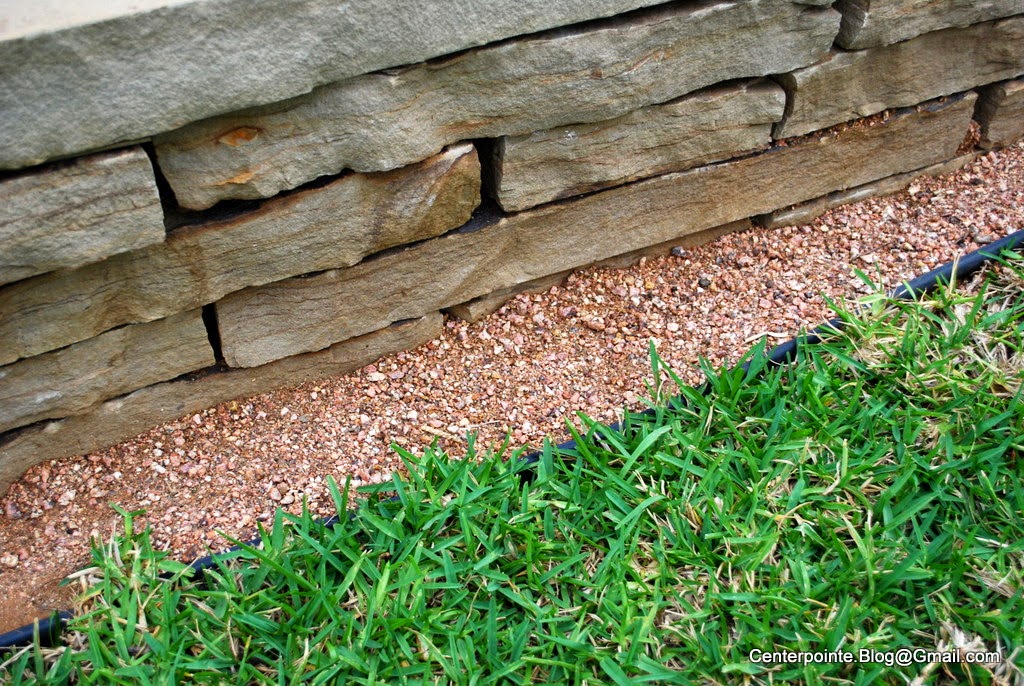
A rare sight: our first stacked stone landscape bed in the greater Houston, Texas suburbs.  I'm hoping that it will stand the test of time, and this post will describe the construction steps that we attempted in order to make it so. 
Let me ask the same question in a relative rather than an absolute fashion.  In greater Houston, we don't have the best track record of making houses that stand the test of time, or roads either, for that matter.  I can't find a reference for this, but I've read that one of the reasons why our freeways are not stacked as they are in Austin and San Antonio has to do with soil instability - the soils can't support stacking structures in many areas (at least not for a price we can afford).  If these things are the case, if with all of our wealth and technology we cannot even stack our freeways around here, what chance do we have with landscape beds?!
The bane of our collective upper Texas coast existence:  interior damage to a home as possible evidence of foundation settling and/or breakage. 

Screengrabbed from Houston realtor Bill Edge's article on how to care for your home's slab foundation
Some folks may not be aware of the scope of this challenge, so let me explain just a bit further. 

Here in greater Houston, most areas are underlain by clay-rich soils that shrink and swell with changes in moisture level.  They're constantly on the move to some degree, and this can wreak havoc with all manner of structural improvements.
I'm citing greater Houston because we live here, but unstable soils are also found in many other areas of the country.  This diagram illustrates the principles of foundation reinforcement. 
Screengrabbed from the website of Buildet Foundation Repair of St. Louis Missouri.

This is a small-scale example from a location within the City of Houston.  Do you see how the sidewalk segment attached to the manhole is newer than the rest of the sidewalk (concrete is bright white)?  That's because differential settling lowered all of the surrounding sidewalk, but the manhole shaft acted as a fixed pier which kept that one segment elevated while the rest of the soil sank by several inches.  The City later came back and replaced that segment so that folks would not trip over its raised edges. 

Screengrabbed from Googlemaps Streetview for a location in the Clear Lake area. 
To make a long story short, after quite a lot of research and consultation with a professional landscaper, I decided that I would not attempt to oppose the forces of nature as they manifest on the upper Texas coast.  I decided to make my stacked stone improvements "float" rather than trying to make them rigid.  That way, even if the underlying soils shifted over time, I could simply respond by re-leveling the structures rather than by having to demolish and build all over again. 
You don't have to go far before you see an example of the rigid-structure damage I'm talking about.  Here's a low landscaping wall split because of shifting soils (or so it appears).  The location?  Galveston County Courthouse Annex on Calder Road. 
To show you what I mean, I'm going to detail the build sequence of our first raised planter bed.  I'm actually going to show two different methodologies (Part 1 and Part 2 of this post), with the first being the approach for which we hired local contractor Greenscapes Lawn and Landscaping

One of the most important things you have to remember, especially if your house is new, is that the its construction involved a lot of soil disturbance and infill, especially adjacent to your slab.  That's a necessary process associated with grading suburban lots and building slab foundations.  This pic shows our front entrance shortly after the walkway was poured.  You can see that a lot of soil was "missing" from this area, which means it had to be replaced...
 
...and the way they replace it is by bringing in dump trucks of fill, which is often a sandy material.  This then gets bulldozed around the lot for proper grading and leveling.  You'll see this distinctive orange color in some photos that follow. 
 
We got past our mental roadblock on front-yard landscaping on the day when we encountered these particular pallets of stone, which we found at Sunland Nursery, 402 FM 646 between Highway 3 and IH-45 (basically, about a half mile northeast of the huge shopping complex at FM 646 and the freeway).  Sunland doesn't appear to have a website, but it's run by an older gentleman named George. 

I had a "Eureka!" moment because these sandstone segments are much larger than any other chopped stone that I had seen for sale around here - in particular, they are wider.  It occurred to me that maybe it had a better potential to "float" because each one would distribute its considerable weight (20 to 60 pounds per piece) over a larger footprint. 

The moment of financial truth as the stone gets set on the scale.  Stone is most often sold by the pallet around here, and prices have risen steadily in the past couple of years.  Generally you can expect to pay in the range of $0.17 to $0.27 per pound (as of spring 2013), depending on the type of stone.  This will make each pallet come out to around one thousand dollars. 

Yes, you heard correctly - a grand per pallet.  That is the unfortunate reality of living in a geographic area where we have no suitable natural stone for hundreds of miles in every direction.  This stuff got transported in from Oklahoma, so the price reflects the considerable cost of transportation.

The other cost represented in that price is the cost of labor.  George the landscaper told me that, when he requests this cut, his supplier complains bitterly about having to chop the rock into these wider pieces.  It's difficult work. 

Initially, my husband and I were not planning to put this much investment into our foundation beds.  We were instead planning to save the lion's share of the budget for making a nice flagstone courtyard in the center of our lawn.  However, when we saw this specialized stone, we changed our focus because we really liked it. 
 
So, OK, this is what our front bed looked like prior to any work beginning (except I had scraped off and tarp'd the top layer of mulch and pulled out a few central shrubs).  It was just an ordinary on-grade suburban foundation bed edged in the same kind of sandstone, but a much smaller chop.  Nothing terrible about this, but nothing distinctive or special, either. 

As I mentioned in this previous post, this was simply a mulch bed set on grade.  It followed the contours of the lot, which is strongly sloped between these two houses to promote efficient rainwater drainage.  For this reason, the bed had the visual appearance of "sagging" to the left, into the drainage swale. 

Again, nothing terrible about this, but it's very ordinary.  Not much sophistication to the construction or the design.  It began its esthetic life as a bunch of mulch simply tossed on top of the builder's graded suburban lot. 
 
OK, now we're beginning to excavate for the stacked stone foundational support.  Here you see that same orange-colored sandy fill material that the builder had laid down when the house was built. 
 
Somewhere underneath all that soil that had to get disturbed in your yard as your house was being built, there is "native" soil which is undisturbed and for that reason, it's more compacted than the top layers of bulldozed soil and emplaced fill.  In the greater Houston area, that's often identifiable as a relatively stiff clay "gumbo" soil (the stuff that sticks annoyingly to your boots).  In this pic, you can see a hint of it - it's the taupe-gray material visible near photo center. 

If you are able to dig down and set your landscaping improvements upon this native layer, you'll likely have better support.  It's not always practical to do that, depending on the depth of fill. 
 
Support is key.  Here you see the limestone aggregate and crushed granite that underpinned this stacked stone.  That pile in the background is fill excavated from the footprint of the stone foundation. 
 
The limestone gravel is white against the white driveway in the pic above, so it's difficult to see.  Even this basic stuff has to be brought in from the Hill Country, a few hundred miles away.  Houston is underlain by soft coastal sediment deposits with no rock to speak of. 

Corner of the excavation.  The emplaced fill was pretty thick here, given that the lot was built up for drainage. 

Incidentally, if you're doing anything like this, first check your property survey for setbacks and utility easements.  Our original curved mulch bed actually extended into the five-foot setback for this lot line.  That's not such a big deal when there's no structure to an ordinary mulch bed, but with a larger investment like this raised bed, it's important to contain it within setbacks or there could be trouble later on (e.g., when you sell your house, any structures impinging on setbacks will likely be called out as a nonconformance). 
 
After the outline of the bed was excavated, the area was infilled with the limestone and compacted. 

Notice two things here:  first, the footprint actually ended up being wider than the stacked stone will be, particularly in foreground areas where the wall will become thicker due to decreasing grade.  This is important for added stability.  Second, there's a grade step-down visible near the bottom of the photo.  This cut stone is so expensive that you don't want to be underpinning your wall with any more than necessary.  As the grade changes, you can step like this, rather than digging the entire trench to a single level.  If this didn't happen, some of the stone would get buried, at $4.00 to $16.00 per piece! 

Notice the following:  (1) The crushed granite was added on top of the limestone within the generous footprint of the base, the footprint which extends out to either side of the rock which was wide to begin with.  This is all done with the intention of constructing as robust a base as practicable (given cost considerations) to minimize future shifting and settling.  (2) Pink twine was strung to keep the structure on level.  (3) Stone stacking started at the corner, which is a geometric necessity (you can't start anywhere else and have the corner come out properly).  (4) This is a dry-stack methodology.  There is no mortar placed between the stones. 
 Number (4) above is what I meant when I said I decided not to fight nature.  I expect soils in this area to shrink and swell and shift as the years pass, because that's what they do around here.  Instead of trying to oppose this, I decided just to create a robust base, but then if the soils shift in two or five or ten years, I'll simply disassemble this wall, re-level the base, and re-stack. 
 
To say the same thing another way, my principal investment is in the stones themselves.  If I were to mortar them together and then this whole apparatus shifts much like the Courthouse Annex's low brick wall did, I'm going to damage the stones, perhaps irreparably, taking them back apart.  If instead I leave this whole thing float, I'm preserving the bulk of my investment even if it requires future adjustment. 
 
My husband took this line of reasoning even one step further in noting with amusement that, if housing resale prices in Centerpointe soften to the point where we cannot get our stacked stone investment back upon selling this house at some future point, we could simply pay movers to pick up all this stone and take it to our next house, so we could re-stack it there. 
 
Now, on with the final bits of the description. 
 
The actual placement of the stones is an art.  This is natural stone, so it's not all the same thickness or shape.  It's basically a process of iteration to find the optimal configuration. 
 
Using pre-cast cement blocks is much more convenient because they're all identically sized (and also a lot cheaper), but we find it to be nowhere near as beautiful as natural stone.  Stacked stone in greater Houston - the ultimate luxury. 

I'm really happy that we decided to include crushed granite in the base like this (it was our landscaper's idea).  It adds another visual dimension, a meatier look, and it makes for an easier lawn-edging task here.  Crushed granite will become even more important in Part 2 of this post.   

BEFORE and AFTER:  "Builder basic" becomes bodacious.
In summary, the keys to this dry-stacking approach are as follows:
  1. The stone is wide enough and heavy enough to bear the weight of the soil in the bed behind it without needing to be physically fixed.  Narrower stone would not work without structural reinforcement. 
  2. The wall is low enough so that significant shear stress does not occur.
  3. The base is robust enough (hopefully) to minimize the effects of shifting.
  4. The stones are overlapped for optimal weight distribution.
  5. The stacked stone is plumb and level so that there are no lateral forcings that would exacerbate a shrink-swell-driven tendency for the entire unit to gravity-creep.  Remember what I said three or four times when describing how we built our cinder block cactus garden: whatever it is, build it level.  If you fail to do this, you can expect misery, and sooner rather than later. 
OK, so I know you're wondering:  What the heck did this latest suburban tract home escapade of ours cost?! 
 
Here's what went into the bill from Greenscapes Lawn and Landscape
  1. One pallet of this very expensive stacked Oklahoma sandstone 
  2. About a yard each of crushed granite and crushed limestone
  3. Transportation of all materials
  4. Labor (one day of work for the landscape supervisor and two apprentices)
For those of you who are regular blog readers:
YES, I tried to find an honest construction contractor who is operating above the law, including where tax payments are concerned.   Note the date on that invoice stub - April 29, 2013.  I signed that contract and paid this bill almost a month before I raised those potentially uncomfortable questions about the source of labor for the building of League City's new Public Safety Building.  I do actually try to put my money where my mouth is - in this case, literally. 
Greenscapes Lawn and Landscape is owned by a young man named Joe Cunningham.  He's from another part of America where construction business doesn't exactly take place like it does in Texas.  He told me that he's paying his taxes and I was inclined to believe him.
 
Could you get a stacked stone bed built around here for less than that amount shown above?  Almost certainly.  Could it be done for much less but still with equivalent construction care by an experienced professional who is actually declaring their income?  Please drop me an email if you find such a contractor. 
 
Anyway, now you know the secret as to why my husband and I are such consummate DIYers: if we limit ourselves to using legitimate contractors, we can't afford to do very much contracting.  Of the massive amount of customization work we've done on our house over the past three years, this was the very first time that we hired someone. 
 
In Part 2 of this post, I'll describe our second stacked stone bed, the supportive base for which my husband and I designed and executed ourselves, and which is different from the method shown above.  Stay tuned. 

Wednesday, March 13, 2013

Pedestrian Pete

A man after my own heart, to be sure.  Pedestrian Pete leverages his unique personal history and name recognition to draw attention to the abysmal condition of Houston's sidewalks.  This FOX clip (embedded below) is fun to watch.  Perhaps I should develop a sidewalk-promoting alter-ego, too, instead of merely ranting about it ad nauseum.  Oh, wait - this blog is my alter-ego. 

Houston weather, traffic, news | FOX 26 | MyFoxHouston

Tuesday, February 19, 2013

World's narrowest sidewalk?

I've had plenty to say in this blog about our sidewalks - the way ignorant homeowners treat them, what people do to push back, the price we Centerpointers collectively paid for the rare and locally-popular segment of sidewalk along West Walker Street, which I refer to as the Bridge to Nowhere because it doesn't currently connect to much else, the consequences of our society's general lack of sidewalks, the specific growth impediments caused by League City's lack thereof, and impacts of threatened future failures to include sidewalks

Today, for a new twist on an old theme, we have this gentleman to ponder.
Out for a stroll during rush hour - but that's a narrow curb he's balanced on, not a sidewalk.  Because there are no sidewalks here, either.   
League City Parkway westbound before West Walker. 
Being a student of human nature, I watched this gentleman tightrope all the way down League City Parkway to his destination which was apparently the Gas Dude, and then all the way back eastward to an unknown location - never leaving the curb, the flat top of which must be all of about six inches wide.  No shoulder to the road and cars rushing by at about 50 miles an hour within about three feet of him.  As he walked with an apparent beverage raised in his right hand. 

In terms of self-preservation, this strikes me as an exceptionally poor strategy, but he seemed to come through it OK.  This time, at least.  I still think that my pic of those young people walking in the traffic lanes across FM 270's Clear Creek bridge with their backs to oncoming vehicles is the most hazardous non-sidewalk scenario I've photographed to date, but this one is perhaps a close second. 

Monday, February 4, 2013

Sight-seeing while fright-seeing

I had a ridiculously large number of local business meetings last week, and not everything I saw fell into the fright-seeing category, so I thought I'd share a bit of that for the sake of amusement and reflection.
The taggers have been hard at work lately, but some slogans are more palatable than others.  This anonymous creation apparently raises the ire of few, because internet reports suggest that it has remained unremediated for at least six months. 
View from the other direction.  Ah, the boundless optimism of youth...

Now this is an iconic traffic photo if I've ever taken one. At first I was a bit perplexed at that officer in front of me, who cruised straight through the intersection without paying the dangler any heed. But then he turned around, probably to deal with it.
 
Almost 20 years ago, a 911 operator ripped me a new one for reporting this kind of thing. It was on a very windy day and the dangling traffic light was whipping around at the end of its electrical cord. Afraid it would smash down at any moment and crush to death a driver or a child in a passenger seat, I dialed 911. The operator chastised me, claiming that this was not a 911-worthy event. We argued the point and exchanged some expletives between the two of us, and then I hung up. With that memory in mind and given that HPD was already in front of me, I didn't report this one the other day.
 
I mean, think about it. Look at the size of that light fixture relative to this police car in front of me. Do the whole force = mass times acceleration (f=ma) thing in your head. Acceleration due to gravity over approximately fifteen feet of free-fall. Mass of several hundred pounds. Windshield or rear window of car providing no protection to humans. Basically, if a thing like this falls and strikes a car in the wrong place, we've got dead people on our hands.  Do we have to wait for serious injury or death to actually occur before we call 911, or can we anticipate a substantial risk and act accordingly?  Apparently that's a matter of interpretation. 

Along the same theme, I also dialed 911 once because a fence had broken and an entire herd of panicked cattle was running loose on FM 2351.  Cars were flying in every direction trying to avoid them.  The 911 operator was summarily unimpressed by my sense of urgency.  I said, "There are multiple eight-hundred-pound projectiles hurtling down a 50 mph roadway full of traffic, and you don't think this situation demands immediate attention?!"  

Blogger is apparently failing to preserve font sizes again...
Along the same lines:  Should we call 911 for an incipient situation like this, or wait until the resulting "sinkhole" grew large enough to actually swallow a car and then dial 911?

Do you see the water bubbling up through the seam in the concrete?  This most likely indicates that a pressure main has ruptured at depth.  As the water shoots out of that broken pipe, it erodes and liquefies the soil surrounding it.  Eventually, the overlying strata and road will collapse into the resulting hole, which Houstonians tend to refer to somewhat euphemistically as a sinkhole. 

In this case last week, I didn't have to debate whether I should alert authorities.  Under the IH-610 bridge, you can already see that an HFD truck has arrived on scene.

And yes, I know that we have non-emergency contact numbers available to us. Have you ever tried to dial one? You get into the queue with all the other non-emergency people who are calling in to complain because the sidewalk is cracked in front of their house. Good luck with that avenue of inquiry. 

From hemorrhaging water to hemorrhaging money:  why exactly are we, the taxpayers facing insurmountable debt, spending about a gazillion dollars ($86 million, to be more precise) on "beautification" of the Mickey Leland building?  Is all this necessary?  KTRK asked the same question not long ago.  This HAIF thread talks about some possible bona fide structural problems.  This doc suggests its being done via stimulus spending.  But no comprehensive cost justification jumped out at me from the quick internet search that I did. 
Not everything I encountered on the road last week was a disaster waiting to happen or an annoying affront.  Some of it was amusing and/or just plain cool. 
Have you seen these guys on FM 518 just east of IH-45?  What we can't figure out for the life of us is why there always seems to be a costumed guy plus some other guy standing back in the shadows.  Is this other guy just paying a social call, or is he somehow an active part of the overall advertising package?  Because you'd think that holding a banner while dressed as Liberty would really be a one-person job. 
Closer to home, our Centerpointe stormwater ponds resident hawk seems to be doing very well.  Here he is sitting on the "For Sale" sign for that tract on the east side of West Walker, during a stunning sunrise. 
I've been watching that "For Sale" tract like a hawk - get it??  And I got a bit excited last week when I saw two guys with a Mule out there, one of them wearing a cowboy hat, which often signifies "developer".  It wasn't until I got back to my office and looked at my hastily-taken pics that I noticed what appears to be a model airplane beside them. 

Oh well.  I will keep watching like a hawk.  As will the hawk. 
Happy Monday - which, by the way, is one of the new trash days for many of us, as wasteful (pun intended) as they are