Showing posts with label Pets. Show all posts

Wednesday, July 30, 2014

DIY dog crate carrying bag

You are not likely to find something like this in the American consumer market.
That's a standard steel folded dog crate for a medium-sized dog (the crate has a 2' x 3' footprint), and the crate memory foam pad, both tucked into an oversized shoulder bag.  In this post, I will describe how I created the bag.   
The reason why you won't find this product for sale is that it's a spinal injury lawsuit waiting to happen.  In other words, manufacturers most likely won't produce carriers for fear of liability.  Even though steel dog crates are designed to fold flat and therefore presumably are intended to be moved from place to place, they are heavy and awkwardly large, and yet the result is that there's nothing on the market (that I have found) in which to carry them.
If you search for a carry bag product in the commercial market, mostly what you're going to find is flimsy nylon portable dog crates, "travel crates", some of which do come with an outer sack for carrying them.  But a dog's crate is her castle, and my 45 pound mutt considers hers to be her Linus blanket.  She would not do well in a tent-like portable crate.  She would chew through it and then there would be no crate at all.

Screengrabbed from Google image search for 'dog crate carrying bag'.  
My husband and I are physically fit and therefore it is not a problem for us to carry an oversized tote bag with a heavy load.  In the photos below, I will show the sequence of easy steps that it takes to create this item.  These instructions assume that you know how to operate a sewing machine, but advanced skills are not required.  
To create a sack for a crate this size, you're going to need a good sewing machine (mine is a 10-year-old low-end Kenmore similar to this one), approximately three and a half yards of 56" wide light upholstery fabric, and extra strength thread, what we used to call "coat thread" when I was a kid.  
I'm saying "light" upholstery fabric because there are limits to what most consumer-grade sewing machines can handle in terms of fabric thickness and (more importantly) fabric density.  If you've got access to a heavy-duty sewing machine, you could perhaps choose a heavier material such as canvas.
This was a textured velvet fabric that I had left over from a home theater drapery project I did many years ago, back when I owned a McMansion with a separate theater room.  This is the fabric laid out on top of the crate before sewing.  Our dog is very attached to her crate and was made anxious by the fact that I was working with it.  She would plop herself forlornly on top of the project at every opportunity.  

I cut a 90 inch length of the fabric and doubled it, wrong sides together.  Normally when sewing, you would primarily work with right sides together, but I was making this bag in a double fabric thickness.  

I don't present a lot of measurements in this post.  I mostly made this bag free-form by fitting it step by step to the folded crate and crate pad.  The first step was to fold the doubled fabric in half, selvage edges together, in order to determine how deep the "lip" around the top opening of the bag had to be.  
Remember to straighten up your fabric before starting this process, making sure that the edges are in parallel and that the bias is on square.  We have ceramic tile through our entire house and it makes a very convenient measuring template for large projects such as this.   
Here I'm folding down the two edges of what will be the top opening of the bag (the "lip"). In other words, I finished the top edge before sewing up the two sides.   
Your main limitation with this project will be what your sewing machine is capable of plowing through, thickness-wise.  Mine is just a low-end Kenmore, but I tell you, the thing is a hawse (sorry I can't find a good slang definition to link to that).  It'll sew through quite a lot of thickness.  
This photo shows the opening "lip" created, with the seam side turned outward, because I didn't want the crate to catch on the edge as I was slipping it in and out of the bag.

Additionally, I had sewed up one side of the bag and then put the crate and pad back in it, in this partially-finished state.  For projects like this that do not need to be precise, I find it more efficient to fit as I go, rather than sewing based on measurements that I've made.  So for instance, if you use a thicker crate pad, you'd want your bag to be slightly larger than this one so that it would accommodate the extra bulk.

Don't make your bag too tight.  There's no reason for that and it will only make it more difficult to insert and remove the crate and pad.  The crate has many wiry edges.  It will tend to catch on fabric.   
Now I've sewed up the second side.  
A steel crate is heavy, so I needed big wide thick shoulder straps.  I created them out of two twelve-inch lengths of the same upholstery fabric.  
I half-folded the wrong sides together like this.  
Then I folded over the end pieces so that they could be stitched first.  
Once the ends of the straps were sewed, I folded the straps together again, seam edges on the inside, and stitched all the way around each perimeter.  The resulting strap is approximately three inches wide, four layers thick.

Then I experimented with placement on the bag, as to what would be the best strap length and position.  I decided on this configuration shown above.  Again, no precise measurements - I used the tape only to ensure that each strap would be anchored the same distance inward from the sides of the bag.

It was very awkward to sew these straps on using the sewing machine.  At this point in the project, the machine was sewing through six layers of this fabric.  But it was able to handle the task as long as I proceeded slowly.
Once I got the first strap sewed on, I flipped the bag over and positioned the other strap in the same manner, lining the two straps up by feel.  This pic actually shows both straps on top of each other, but you can only see the top one.  
BTW, have you ever seen those popular Facebook posts that say "LIKE if you remember this object!" where they showcase a lot of nostalgic consumer products of yesteryear?   This object shown above was, in fact, featured in a recent mass posting.  When I saw it, I thought to myself, "Like if I REMEMBER this object?!  WTF - I'm STILL USING that object!!
:-)
I would have preferred to run my straps all the way down the side of the bag for strength, the way better tote bags such as this one are constructed.  This tote is by Steele Canvas Basket, which just might be the only remaining manufacturer in America that sells oversized tote bags to the public.  Most of them were taken off the market about 15 years ago because of liability fears (so I was told by a prominent manufacturer when I complained about their sudden disappearance).  Injury lawsuits, in other words.

However, regarding my strap ambitions, with only a light-duty sewing machine to work with, I opted not to get too elaborate with my design, doing only what was needed instead of going for maximum strength. I don't need to be climbing mountains with this crate bag - I just need it to move the crate from house to car to hotel and back again.  As such, I could make do with only minimal engineering.  
Selfie in a smudgy mirror.  This thing is not going to win any design awards, but it only took me a couple of hours to make and it will get the crate-carrying job done.  Not only does it allow me to carry the crate, but it also will prevent the metal edges from scratching the interior side walls of my minivan when it's loaded into the back of it.

Note the visible muscles in my fifty-year-old yoga arms.  If you are not physically fit, I don't recommend that you try to carry a big crate like this, bag or no bag.  You could, indeed, hurt your back or shoulder.   Or both.  

Tuesday, July 1, 2014

The suburban F bomb: Fleas

Yesterday I saw something for the very first time in our four-year tenure in Centerpointe:
It's very a propos that the maker labeled the genitals, given that reproduction is what fleas do best.

Diagram screengrabbed from Wikipedia.  
We do our own dog grooming (it's extremely labor-intensive and very expensive to get a large dog groomed professionally).  We do shaving and trimming outdoors on a table we have set up behind our garage.  Our dog has been kept up-to-date on her Spinosad (Comfortis, which is a highly effective oral flea treatment and preventative) so imagine my surprise when I began shaving her only to discover that she was hopping with fleas.
Proud pic taken post-grooming yesterday:  The spiffiest, handsomest GCARC alumna in all of League City.

Let me say it again because it's important: Four years I've been regularly shaving and grooming this dog, and not once during that time did I find a single flea.  Until yesterday, that is.  This dog spends most of her days snoozing underneath my home office desk and serving as my official foot-warmer.  You better believe she's the cleanest mutt in town.  
Here's the scary part for all of you:  Given that our dog doesn't "have" fleas per se, and given that there are none in our home, and given that any dog correctly dosed with Comfortis simply can't support an active flea population (they will die as soon as they bite - that's the happy miracle of Spinosad), what likely happened yesterday is that the live fleas all piled on her as soon as she stepped outside our door.

In other words, the concentration of fleas in our external environment appears to be abnormally high right now (abnormal relative to the levels I observed historically).  There are probably a couple of factors contributing to this:

  • It's mid-summer, the time of year when fleas are at their most active.

Well, according to this screengrab from Weather.com, they're active year round here, but maybe the 2014 polar vortex had something to do with a summer surge this year.  

  • We seem to have a larger-than-usual concentration of outdoor dogs in Centerpointe right now.  Consistent with this observation, did you notice that most recent email blast from the POA?  Here's an excerpt:

From an email in late May 2014.  It seems like barking issues have been on the upswing.  Think about what that implies:  If a dog's owner is ignoring their dog's physical and social needs to the point where the neighbors are ready to call the police because of the resulting barking, how likely is it that the owner is attending to their dog's medical needs??  Answer:  Not too friggin' likely.    
I have definitely noticed an increase in the number of people keeping outdoor dogs on our side of the subdivision.  Furthermore, I've noticed that some families who formerly kept their dogs primarily inside have transitioned to keeping them outside.  Overall, the number of outdoor dogs has increased, and here is my concern with that:  People who keep their dogs outdoors aren't always as diligent about grooming and flea-treating because they have so much less physical contact with their animals.  They figure, "Our dog doesn't come into our house, so who cares whether it gets those expensive parasite medications on time?"

I will tell you who cares - your neighbors care very much, especially your neighbors who walk their own dogs and then return with those dogs to their homes.  Those neighbors don't want high concentrations of fleas hitching a ride on their treated dogs long enough to get inside.  For while fleas can't survive on a medicated dog, if they get a toe-hold in a residence they can instead thrive quite nicely on the blood of humans and other pets that may be present.  And the quality of your life goes downhill on roller skates from there, because fleas are profoundly difficult to eradicate once established in a home.

So please double check your dog's parasite maintenance schedule and treat him or her if necessary.  Like, immediately, because something seems to have happened to change our flea status quo here, and by my observation, it has happened for the worse.
Moral of this story:

If you have an inside dog, even if that dog is treated with effective products such as Comfortis, Trifexis, or Advantage, you would be wise to keep a closer watch on both the dog and your home.  This Aggie site describes the steps that should be taken in addition to dog treatment to ensure that a flea infestation does not occur.   Screengrab above from that site.  

I try to explain to my teenager what life was like before we all had access to technologically-advanced products for flea control, but it's another one of those phenomena like rabbit ears and rotary dial telephones.  You can explain until you're blue in the face, but unless you've lived it, it's just a vague notion of little relevance.  People of my generation will fully understand this meme above.  Younger generations, not so much.  

Thursday, April 10, 2014

League City dog park project revived

Galveston County Daily News reports (paywalled) that the League City dog park is back under consideration after several years of dormancy.  This is important for us in Centerpointe because the location, as I currently understand it, is the same as was originally proposed - the tract of land that is sandwiched between us and the new police station.
This drawing is very preliminary and subject to change.  No specific design has been proposed yet by League City, as I understand it.  
This idea gained a lot of traction several years ago, before my family moved to Centerpointe.
A number of groups were dedicated to making it happen, including this blog site, whose current homepage I screengrabbed above.  They were associated with the local group Bark9.  
However, the movement was reportedly overturned by citizen objection.  By word of mouth, I was told that most of that objection came from within Centerpointe.  I have no details other than that.

Bearing in mind that this blog is not affiliated with Centerpointe POA, I personally am not opposed to a dog park at the stated location in principle.  I have not yet researched the issue, but I see no a priori reason to assume that it would be an automatically bad development (and I am one of the residents who is on the far northeast side of the subdivision, within spitting distance of the tract in question).  As I noted on Galveston Daily News, the area in question is already used daily by people with dogs (including my family), especially the Interurban Easement.  The utility companies don't need to mow that thing.  The path down the center of it is perpetually beaten flat by the constant foot traffic of local people walking their dogs.

We all need to see more detail on this thing before we can make up our minds whether we're ultimately "for" or "against".  On this go-round, League City plans to poll people as to whether they want it to happen.  I will reserve additional comment for the moment, but will post more on this as it develops and as I'm able to do further research.
Centerpointe children overwhelmed my temporarily-free-running dog with affection in this popular post from late 2012 where I spoofed the helicopter-style over-concern with dog safety and child safety.

According to GCDN
, Councilman Becker adamantly opposes a dog park in League City for safety reasons, but to me, B doesn't follow A on that logic.  If you look at the number of dog-related injuries to humans vs. the circumstances of those injuries, I rather doubt that dog parks are strongly correlated with increased risk.  It's analogous to any other form of abuse - the primary source of concern is not "stranger danger" but rather conditions within a person's immediate environment.  The very recent pit bull attack on a League City toddler took place within that family's private residence, consistent with that idea.       

Monday, March 10, 2014

How to silence dog tags

Answer:  To stop dog tags from jingling, use two criss-crossed strips of double-sided half-inch hook-and-loop (trade name Velcro) to bundle them to each other.

The Velcro has a minor disadvantage of getting a bit of dog hair tangled up in it, but that's a small price to pay for not having your dog constantly sounding like the Salvation Army bell ringer.
It won't win an award for attractiveness, but it gets the job done and, in four years of dog ownership, it's the only solution I've come up with that actually works for more than a short duration of time. Our dog managed to rip every other silencing device off her collar.  I can't even speculate how she accomplished this, but it happened.

It's essential that your Velcro be double-sided across its entire length so that each piece will bind both to itself and to the other piece which overlaps (this keeps it from slipping).  Some products are either hook or loop but not one of each on each side.

Make sure you put the loop side of the Velcro on the outside.  If you attach the Velcro with the hook side out, it will accumulate more dog hair.  
I am not the first one to call attention to this exasperating problem, which is especially relevant to us because I jog with our dog.  Without something to quiet her tags, she literally sets every other dog in Centerpointe to barking.  Whether they are inside dogs or yard dogs, they can all hear her as we go by.
Others have tackled this problem, but they haven't necessarily succeeded.

Screengrabbed from this eHow page.  
I tried a couple of the solutions listed in that eHow piece, but they did not work.  This Velcro idea works.

And given that only a few inches of narrow-diameter Velcro are required, this idea costs only pennies to execute, not the few bucks that you'd pay for commercial silencers (if you can even find them to buy, and if they'll even stay on your dog's tags, which mine did not).
This is very similar to the product I used, although I certainly didn't buy 25 yards of it.  You can get smaller rolls at the hardware store.

Screengrabbed from the Zoro Tools website.  
If anyone needs to read your dog's tags, they can just peel open the Velcro.  Piece of cake.

This is what happened on one of my earlier trials when I made the mistake of putting the hook side of the Velcro facing out.  The hooks caught more dog hair.  Putting the loop side out eliminates most of this issue.

Friday, November 15, 2013

UPS yours

Our security cameras revealed the reason why our dog flipped out at 10:10 p.m. last night, scaring the bejesus out of us after we had all gone to bed:
Yes, that is actually the UPS man, at that hour.  And our dog would like to disembowel the UPS man.  She does not take kindly to unfamiliar people who stride aggressively to our door.  Such people break all the rules of canine decorum. 
You might see a delivery truck such as this after 10 p.m. and assume that it's a fake, some kind of a cover for a criminal operation.  They're really not supposed to be delivering past about 8:00 p.m., but for whatever reason, the local distribution node has been having issues that cause them to run way, way behind schedule on some days.  A month or so ago, I encountered this while waiting for a signature package.  The website said it was "out for delivery" on the truck, but the truck never came.  Around 8:40 p.m., I called and asked what the deal was.  They told me that it might get there by 10:30 p.m.  I guess they expect us to clamber out of bed in our pajamas to sign for packages.

Anyway, keep this in mind as the holiday season approaches, because the problem might very well get worse.  If your bell rings in the dead of night, it's not necessarily a prelude to a home invasion, so please don't shoot the bell-ringer on general principle.  My dog would be so disappointed.  She is really hoping for first dibs. 
:-)
Substitute "UPS man" for "mailman".  My favorite barking meme.  I would credit the maker if I knew who it was.

Tuesday, November 12, 2013

Challenging chelonian

There's a story behind this one and I really wish I had the time to track it down (oh, to be a real journalist), because it has a high probability of being absolutely hilarious.
Can you imagine cruising down Centerpointe Drive and seeing the likes of this hoofing through the grass beside you? 

Image courtesy Centerpointe POA, which probably got it from somebody else. 
Did anybody not look at the POA's email blast and yell, "HOLY SH*T"?  This thing is bigger than Dallas! You could saddle it up and ride it home!  "Take me to your leader - yah, giddy-up!!!"
:-)

Anyway, it's just another day in paradise, obviously.  Here's hoping that the traveling terrapin is reunited with its humans. 

Sunday, August 25, 2013

Dog ate soap - what to do (warning - graphic image)

Sit back and prepare thyself for an onslaught of barfing and diarrhea, basically.  If it was a consumer grade of bar soap, it probably won't endanger the dog's life.  When in doubt and depending on your circumstances, double check with your vet, but the chat boards seem to be unanimous on this one (e.g., here and here).  Basically, soap ingestion seems to be more of a roaring inconvenience than an emergency.  But nobody is going to be comfortable, neither canine nor human family members, until the sudsy stuff has been passed back out of the system.
This one has far more beauty than brains, obviously, and that big mouth gets her in a lot of trouble.

No, that's not the graphic image I was referring to in the post title, but you'll want to quit reading now if you wish to avoid it.  
Back in 2011, I described how this very same adorable mutt chewed on sago root and almost died (it's still not clear how long her liver will last).  Following that horrific experience, we learned to be vigilant when it comes to determining what she ingests at any given time.  With some dogs, the mantra is "eat first and ask questions later".  It's not a question of whether they'll poison themselves - it's a question of when and with what.

We also learned to be adept and quick in identifying the source of any given gastric upset.   In this case, we ran through the usual list of obvious questions:

  • Did she get into the kitchen trash can?  
  • Did the teenager or her friends leave any junk food within reach in her bedroom? (chocolate is poisonous to dogs).  
  • Did any passers-by toss any trash over our fence that she might have eaten?  (we back to a public sidewalk)

We had a poorly constrained variable on this one because we had spent the previous night in an extended-family member's beach house in Galveston.  I had examined the house for dog-proofness, but I had not considered the hand soap as a potential evening-ruiner.  I think she ate it because we don't use scented soap in our house (allergies) and therefore she figured it might be a foodstuff because that particular bar had a strong smell to it.

How did I figure out it was hand soap?
She didn't just chew on it - she swallowed it whole.  Here's the mostly-dissolved core of it, with a screwdriver for scale.  I had to fish it out and examine it because whatever that white thing was, it clearly did not belong in my dog's barf.  It was readily identifiable by smell, even in the barf-coated configuration you see here.  

With both kids and with dogs, steel thy nerves and examine closely any and all vomitus, even as it is staining its way into your tile grout.  This is especially true if you cannot identify the poisoning agent by inference from your surroundings.  
We had a few other clues before all the emetic excitement:

  • She was alternately listless and anxious (not feeling well, obviously).
  • She was reluctant to eat her dinner (I'da thought it more likely that the Earth would stop spinning on its axis).
  • She drooled several times earlier in the day (and she never does that).  
  • She drank copious amounts of water in the several hours leading up to the resulting barf-a-thon (which made the clean-ups even more fun for me).  

So there you have yet another suburban existential milestone aptly described.  Happy pet parenting.  Sigh.

This is a very nice graphic (source unknown or I would credit it) showing foods that are toxic to dogs.  Of course, soap is not on here as it's not a food per se...

Friday, August 2, 2013

GCARC de non-triomphe

Sad news from Galveston County Animal Resource Center (GCARC), which appears to be suffering a leadership crisis of the most profound type.
Back in June of this year, when I passed on the information about the shelter reaching capacity, I could not have imagined the allegations that are now surfacing.  We didn't witness anything remotely like the conditions now being described when we adopted our dog from GCARC.  The staff and volunteers at that time (3 years ago) were wonderful and the animals were well cared for (we went into the kennel areas on two occasions and saw a great deal of the facilities).  And we did our adoption BEFORE the shelter's $5 million physical expansion, back when they had far more modest accomodations. 
But we were also there BEFORE Kim Schoolcraft resigned as its leader amidst an initial wave of controversy.  Could these factors be related?

The shelter has been the subject of at least one expose' presented by KHOUVolunteer groups are disgusted with the status quo, and just as an army marches on its stomach, an animal shelter marches on its volunteer base, so losing them is the kiss of death. 

Discussions are underway on how to resolve the problems, possibly via out-sourcing of its management.  Whatever happens, I hope a turnaround can occur quickly, for the sake of all involved. 

Saturday, July 6, 2013

Never leave pet food outside!

If you leave uneaten pet food outside, the rat population will explode.  It's that simple. 
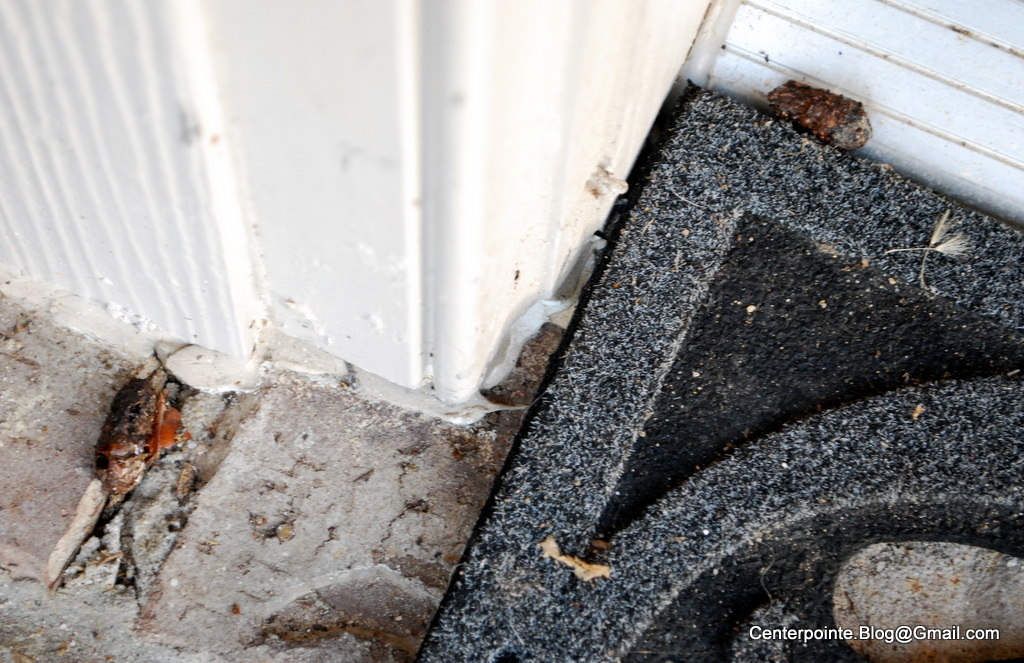
Learn to recognize the signs:  This is a steaming fresh rat turd on our front stoop next to the "Welcome" mat.  Welcome, indeed. 
This problem is two-fold. 
  • First, people leave pet food and/or bird seed outdoors unattended, never imagining that more than birds or pets might be eating it. 
  • Second, then when a plague of rodents does predictably mushroom in direct response to this overabundance of food, people fail to recognize the signs, the most obvious of which is droppings such as the one shown above.  Not recognizing the signs, they don't modify their pet food management practices. 

Learn to recognize the signs:  Here are two more turds at the same front entrance, only now you're looking at aged turds which typically become lighter in color and more dried out. 

Lately, I've actually had to sweep turds off our front and back porches, there are so many of them.  The rats are running wild during the night and their turds are visible the next morning. 
Pet food mismanagement has become a problem at one point or another in every Texas suburban neighborhood I've lived in during the past twenty-odd years.  It was not a problem in the recently-built Centerpointe Section 9 until a couple of months ago.  When this subdivision was first built, we had mice.  But mice and rats tend not to occupy the same ecological niche, and it seems that rats have now come in and displaced the original mice. 
Learn to recognize the signs:  UNESCO produced this handy comparison diagram.  Rat turds have blunt ends. 
There are many natural food sources for rats, especially during the growing season, but I'm focusing on pet food because it's so superior for them.  Rats are like any other mammalian species - they require the same three macronutrients (fats, proteins, and carbohydrates) in order to thrive.  Pet food optimizes that balance.  It frankly amazes me that I now see as much rat activity as I do, and yet I haven't seen a single bit of damage done to any of my back-yard vegetables.  But vegetables alone will disproportionately supply carbohydrates, and no self-respecting rodent would dine on tomatoes or squash or cauliflower or blueberries or anything else grown in soil when a more complete meal is readily available for them.
I've currently got about ten million of these things in our back yard, and they remain untouched. 
The rat situation is so bad here right now that we've decided to try a new approach to controlling it.
Bait stations ordered over the internet.  Lots of them. 
Historically, I've dealt with suburban pet-food-driven rat infestations by physically trapping them rather than by poisoning.  However, they are best trapped inside houses, and we are now in the wrong season (summer) for that.  And I don't want to leave snap traps or glue traps outdoors at this time of year because both children and other small animals (including Centerpointe's outdoor cats) can be seriously injured by them. 

But baits are not ideal either.  They raise the possibility of some rats dying in locations where they can then be eaten by other wild animals or pets, which then ingest the same poison and perhaps proceed to die themselves.  Or curious children might contact a carcass, which is potentially dangerous from a disease perspective. 

Despite these reservations, we deployed the bait stations anyway.  With as much rat sign as we are now seeing, if we don't somehow reduce the population quickly, they will begin moving into our neighborhood houses when the weather gets colder this autumn, as rats will do.  And at that point, we would all have a much larger problem if they remained unchecked. 

I will be going door to door in my section of Centerpointe, asking people about their pet feeding practices and showing them the turd pics above.  I encourage folks in other sections of Centerpointe to do similarly.
Number one rule of rodent control:  Deny them their food. 

Wednesday, June 19, 2013

Capacity reached at Galveston County animal shelter

GCARC did a press release a few weeks ago announcing that they had max'd out their capacity with six hundred and forty five (!!) adoptable pets in residence.  I would have posted about this sooner had I been aware of it. 

Distinguished GCARC alumna:  our dog is a constant source of public admiration and people frequently ask us what breed she is and which breeder we ordered her from.  Her breed is that superior lineage known alternately as "mixed" or "Heinz 57", and the "breeder" (or at least the breeder recipient) was Galveston County Animal Resource Center (which is a euphemism for "animal shelter"). 

Yes, in most cases, it's goofy to put clothing on dogs.  However, because she's an inside dog, we have her shaved and groomed on a regular basis, so she is terribly vulnerable to cold weather (this pic was taken in December).  Without her insulating under-coat of fine fur, she'll shake like a leaf when taken outdoors in winter if we don't dress her up like this.   
GCARC is wonderful and I highly recommend it.  Their staff is very helpful with each stage of the adoption process, and we could not have gotten a better dog. 

But let me go one step further than that endorsement, and explain an animal shelter reality that nobody likes to talk about or ask about or even think about, given that it is an overwhelmingly emotional subject. 

Many people are afraid to adopt from an animal shelter because they're worried that they'll get stuck with an animal who was abused and who behaves neurotically and dysfunctionally as a result.  Or they're afraid that they'll get an animal who is set in his or her ways, who they later discover was not properly socialized, or whose temperament and energy level is simply not a good fit for their family.  To be "on the safe side", they would rather order a young animal from a breeder whom they trust to do a good temperament matching on their behalves.

Well, here are my observations on that stereotype.

First of all, the "safe side" isn't always so safe.  Breeders don't always make the right calls about the temperament of their stock.  I have a couple of friends who ended up with purebred dogs from hell because of this (I personally don't care if I ever see another Jack Russell again in my life, after seeing the likes of what a few acquaintances purchased). 

Second of all, most shelters will give you a chance to properly evaluate your animal.  Most have ownership grace periods of a few weeks to 30 days during which you can return an animal and you won't be judged if you do this.  You'll probably lose your adoption fee because that may have covered your candidate's shots and spay/neuter, but that's small potatoes compared to the overall costs of owning a pet, so who cares?

But this idea of returning an animal utterly horrifies many people.  Pets have become so personified in our culture that people feel as if returning a dog to a shelter is tantamount to abandoning a newborn baby to die in a ditch somewhere.  People get so acutely emotional about pets that they experience tunnel vision when presented with a potential reality like this. 

I know what of I speak, because this happened to us and I was very surprised at the ferocity of the response I received.  When I announced that we had to return our first canine candidate to the shelter whence she came, members of my own extended family positively snarled at me, "How could you simply kick that dog to the curb?!" as if the entire pet overpopulation problem was solely my personal fault.
This was the first beautiful dog we brought home from the League City Animal Shelter with the sincere hopes of integrating her into our family.  She was two to three years old and she obviously had been socialized prior to entering the shelter, but unfortunately, we came to understand that she had not been raised around children.  She absolutely refused to relate to our then-younger child, whose dreams of having a best-canine-friend relationship would have been crushed if we had decided to keep her.  In the few weeks that we had this dog in our home, mostly what our child did was cry and cry and cry because she felt so rejected by her. 
The folks who snarled at me were suffering from emotional tunnel vision and were only seeing one side of this equation.  The fact is, the rates of euthanasia are extremely high in our local shelters - some estimates put them as high as 85%.  We were only in a position to save one dog's life, and it had to be a dog that fit with our family.  When we took that original dog back, I was very careful to explain to the shelter that she had no behavioral problems but needed an adult owner.  I also made sure I had taken her to a supplemental vet visit and had wormed her and begun heartworm preventative, thus paying some of her bills in advance to maximize her appeal to a future adult owner.

The League City shelter is much smaller than the Galveston County shelter and, at the time, they did not have a large number of dogs to choose from, so we decided to try our luck at the County shelter.  And that is where we found the likes of this:
Little Red Riding Dog, the single most playful and foolish mutt on the planet.  An absolutely perfect companion for a child.  All the neighborhood kids just love her.  Even a few of our neighbors who dislike dogs are receptive to her. 
If we had kept that original yellow dog, chances are excellent that the totally lovable creature shown in the photo above would have been euthanized.  The week we went to GCARC to make our selection, the place was positively overflowing with dogs.  I spoke to a volunteer there and it was suggested to me that this dog had about 48 more hours before she would have been put down.  Given the volume of dogs, it is unlikely that another family would have come along to choose her in the intervening hours. 

There are three morals to this story. 

First, never underestimate the value that a public animal shelter can offer to you.  They do have good dogs, and you will find one if you take the time to vet them, as you are entitled to do.  Good shelter personnel will not scorn you the way my family scorned me.  They will instead be kind and understanding in helping you with every step of the selection process, which they will realize is an imperfect and difficult process at best.  The GCARC personnel treated us with complete understanding and respect - they know full well that the adopted animal has to be the right fit or it won't work for the family.  And that fit doesn't always happen on the first try.  That's just the imperfect reality of it. 

Second, don't be intimidated by anyone else's emotionalism as you do what's best for your own family.  If someone can't parse the bigger picture in a situation like I just described, that's their problem, not yours. 

Third, this story is a parable of life, and it has been one of my daughter's most important learning experiences growing up.  Life is not perfect and it sometimes requires us to make wrenching decisions.  One day, it's not going to be an unsuitable dog from whom she must decide to separate - it's going to be some immature boyfriend.  She was heartbroken at having to send that first dog back, but she also realized that we didn't have a real choice in the matter, because it just wasn't the right situation.  It takes guts to make a decision like that.  How many people do you know who persist in a relationship with the wrong person because they just can't muster the courage to move on and grow as healthy adults?  My daughter now has a powerful precedent.  She separated from her first canine candidate as compassionately as she could, and then went on to find the right permanent canine match for her ('til death do them part, without question).  May that extraordinary lesson stay firmly with her as she now begins to transition into her young womanhood. 

You almost certainly save a dog's life if you choose from a shelter.  If we had been emotionally unable to make the uncomfortable decisions I described above, this perfect foolish red-caped dog would have died.  Maybe we would have found a breeder able to get the temperament call correct on his or her first attempt, but knowing what we know about the euthanasia rates at animal shelters, that would have been a hollow victory for us.  Too hollow to accept as an option. 
Recent neighborhood scratch-a-thon from this post which was tweeted by a well-known journalist and read with amusement by folks all around the whole world. 

Wednesday, May 29, 2013

Another found dog

If you live in the vicinity of Centerpointe and you lost this dog today, please contact either the POA or the undersigned to claim.  POA link is in the left hand column of this blog. 
I sure wish we had a centralized lost / found animal clearinghouse in this area, because pet reunification is a common goal around here...