Showing posts sorted by relevance for query sidewalk. Sort by date Show all posts

Wednesday, October 24, 2012

The Public Safety Building sidewalk issue

Remember in this post I had published a screengrab similar to this one:
Screengrabbed from this PDF as published by League City and dated September 17, 2012.
Yesterday I sent that grab to a collection of LC elected and administrative personnel along with this picture-tells-a-thousand-words:
West Walker just past the Interurban easement.
That sidewalk you see in the photo above is ours, meaning, it belongs to the public but we Centerpointe residents were the people who collectively paid for it because its price tag was rolled into the costs of buying a home in this neighborhood. 

I confirmed this via emails with our developer yesterday.  That approx. one mile of sidewalk stretching from this terminus all the way to State Highway 96 was a required component of the subdivision development plan approved by League City ("PUD plan" or "PID plan" or whichever the heck acronym applies).  Some of it doesn't even run in front of our subdivision but let me not even go there. 

So if I'm understanding our developer's description of this situation, what falls out of it is the following observation:

The continuation of this sidewalk to points east as these additional properties are developed... this is not just a matter of principle or aesthetics or me personally advocating healthier lifestyles that include places for people to safely walk, jog, or bike-ride, or my desire to see fewer local children run over by cars and killed in part because sidewalks are not available to them and they were forced to either wait for the bus or ride their scooter on the open road instead of on an available sidewalk. 

This is actually a larger issue - there's a property value ramification for us.  If League City does not extend that sidewalk across this new development, it devalues this substantial investment that we Centerpointers were forced to make through our installation of what I'd nicknamed the "Bridge to Nowhere":  a wonderfully broad, very expensive one-mile sidewalk that presently is of limited value because it doesn't connect to anything else.  And would remain of limited value if left perpetually in that condition. 
We paid for it.
We better make sure that we advocate for it.
From a value perspective, that connectivity may not be critically important at this very instant in time, but I strongly suspect that we as a society will continue to move in a direction where pedestrian accessibility becomes increasingly valued (but I won't get off on a tangent explaining why I think that).  Shortsightedness on issues of mobility today will be penalized in the form of lower property values tomorrow. 

For these reasons, this sidewalk connectivity issue is not something that I'm simply griping about.  It's an issue that I'm prepared to pursue with additional actions if necessary, but hopefully I won't have to, because I received an email from League City Communications Coordinator Kristi Wyatt which stated the following:

"City code requires sidewalks in front of the public safety building. Although this is not listed on the project webpage at this time, sidewalks will be included as a part of this project. This project is contracted as a construction manager at risk project, due to this delivery method elements of the project are bid at different times, sidewalks have not yet been through the bid process but will be included in the project."

Hopefully this will prove to be the case and the issue is thereby resolved.  I suppose at this point I could question what on earth prompted the site design engineer to be so detailed as to specify individual trees planted exactly thirty feet zero inches apart along West Walker in his September 2012 drawing, but simultaneously declined to include a major design element such as a sidewalk.  Let me not even go there right now, because the important thing is to see the issue resolved productively, not to find fault with any interim representations. 

So for the moment we will take LC's statement on faith.  But at the same time, I'll be keeping a sharp eye on the progression of that new development.

Tuesday, March 15, 2011

Sidewalk talk

It's never my intention with blog entries to appear preachy or demanding.  We have enough agents (both official and unofficial) in our society who delight in assuming those roles.

I'd rather be a provider of perspective and information and, with that in mind, I'd like to expound upon a point that appeared in the February neighborhood newsletter:

Look at the fourth line down.
I am quite sure that many local residents do not know this:  it is ILLEGAL in many municipalities to block the sidewalk with your car, even where your own driveway crosses it.

Let me offer you a vignette of perspective on this issue before further discussing its practicalities.  I was jogging in the neighborhood about three weeks ago when I happened across a young lady, a prospective buyer, who was viewing a listing for sale on Harvard Pointe Drive.  We chatted about the neighborhood and its amenities.   Seeing my attire, one of the first questions she asked was, "Is Centerpointe a good neighborhood for joggers?  Are all its sidewalks in good condition equivalent to the sidewalks on Harvard Pointe?"  She, too, was a jogger and the availability of good sidewalks were a key factor in her purchase decisions. 

Moral of the story
Access to sidewalks is extremely important to many of us.  Sidewalks are not just bling added to the front of houses to increase property values.  Many of us make active use of them daily. 

Here's a short list of activities that CANNOT be properly accomplished if there is no access to sidewalks, either because they were not installed in the first place, or because they are blocked by multiple cars:
  1. Take yourself jogging.
  2. Take your dog walking.
  3. Push a baby stroller.
  4. Guide a young child on a training wheels bicycle.
We used to live in "old town" League City where you can see majestic 100-year-old oak trees... but you better not spend too much time gazing up at them because you have to constantly jump out of the way of traffic in that area.  Those old neighborhoods were built without sidewalks or even street shoulders.  Many times when we would try to walk there, we would find ourselves literally leaping into open ditches to escape speeding cars.  From a stress standpoint, it was hardly worth it to go outside. 

I personally know some families in Centerpointe who block the sidewalks with their cars, which is why I figure many people who do it are unaware that their actions are impacting their neighbors.  They're nice folks - they probably just haven't given this much thought.

Google Maps tells a tale of the extent of it in Centerpointe:

Sometimes it appears to occur because folks failed to buy or build a house big enough to accomodate all of their cars.  If you can't fit them in your garage or on your own section of your driveway (see plat excerpt below), the street is your other legal parking option.

In my recent observation, the section of Walnut Pointe between the two ends of Lilac Pointe is the worst street in the neighborhood for this kind of thing.  I have often counted as many as a DOZEN blocked driveways just along that one stretch.  Sometimes joggers on Walnut Poine have to go straight down the middle of the street! 
An example of a 2-wide where a car is blocking the sidewalk despite ample room in the driveway.  Even if these folks do not want to park next to each other, they could still probably pull all the way up to their garage so that they spare the sidewalk.
A 3-wide driveway example where blocking the sidewalk is clearly unnecessary!!
Yet another 3-wide driveway where blocking the sidewalk is EVEN MORE unnecessary!!
Some of the less-enlightened among you may be thinking at this point,
"Well, it's MY driveway - I'll park in it any way I want."

Actually, you might be wrong about that, as this survey excerpt suggests:

I am not an attorney and this is not legal advice, but it appears to me as if the documents that legally define the neighborhood state that the sidewalks and the land upon which they were poured are public property, not private.  This would mean that it's actually NOT "your" section of the driveway. 
Anyway, I hope this post begins to raise awareness about this issue.  Thanks for not blocking the sidewalks, from those of us who utilize them daily.  There are so few public spaces in our modern, crowded residential neighborhoods that we need to maintain open access to what little has been made available to us.

Tuesday, September 25, 2012

A fully-avoidable horror story

How much do we value human life?  How big of a priority to we, as a local society, place upon the safety of our children?  These are the questions I encourage you to contemplate as you read this post.

A precious, irreplaceable little girl was struck and killed by a motor vehicle yesterday morning in Texas City as she waited for her school bus to arrive. 
Christina Lopez, age 11, photo screengrabbed from this Galveston County Daily News article.
The circumstances of her passing included exactly those same contributing factors related to infrastructure about which I have absolutely railed in previous blog posts.

The road was narrow and unimproved, with no sidewalk.
According to published reports, this is the approximate location where she was struck.  No sidewalks, no shoulder, just a narrow strip of blacktop over grade.  Who knows what construction standards were in force when this residential street was installed?  Whenever that occurred, the standards included absolutely no provision for pedestrians. 

Screengrab from Google street view.
The lack of essential infrastructure shown above is not rare and is certainly not limited to Texas City.  In a May 2011 blog post titled "Municipal Shame", I showed a dash cam screengrab of a young boy who d*mned-near fell under the wheels of my own car because his foot slipped off the curb as he was walking.  There was no sidewalk available at this densely-populated location in the City of Webster, and he was doing the best he could to walk in the narrow strip of grass between the street and this adjacent private property - but it almost cost him his life, and here once again is my memorable photo of that event:
See his body tipping toward the roadway as he struggled to maintain his balance. 

I was traveling 35 mph when this was taken - if he had fallen, I would have almost certainly struck and killed him because, at such close range, there would not have been time for evasive action. 
And what I spent considerable time railing against wasn't just that incident, or that boy, or that municipality.  This failure to meet the basic needs of our local pedestrian population is endemic:
I still don't have an answer to who the hell in League City approved the plans for the Sportsplex WITHOUT a sidewalk in front of it to connect with the other sidewalks that already exist in front of Star Toyota and also re-commencing at West Walker. 

How F-ing difficult is it to require sidewalks?!  This is NEW CONSTRUCTION - this should have been a no-brainer.  Which one of our municipal wizards was asleep at the approvals wheel when this particular development design was rubber-stamped? 
But of course, as I've also bitched out loud before, we can't even seem to make our own municipal complex into a walkable area!!  No sidewalks here, either, despite the fact that kids converge on the public swimming pool located within this complex!!
In this other post, called "The Bravest Leaguer", the situation was especially telling: a tiny speck of another precious little girl, wobbling down one of the miserably-unimproved streets in Old Town as she tried valiantly to learn to ride her bike.
Where is the simplest public infrastructure that would be necessary to pay even the most basic level of respect to this child's life?

Where is the sidewalk that this child should rightfully have access to? 

There's nothing.  Most of Old Town is characterized by crumbling pedestrian-unfriendly narrow strips of asphalt with nothing but deep muddy ditches on each side.
And it's not just the children who are denied basic safe pedestrian access to our outdoor areas.  Here's a very telling picture that I took just two days ago, because I was fixin' to blog again about this larger issue even before Christina was killed:
Sunday, September 23, 2012, fairly early in the morning.

Do you see that car parked at the terminus of Centerpointe Drive?

Do you ever wonder why cars are frequently parked in this location at the very back of our subdivision, especially in the mornings?
I'll tell you why cars are frequently parked there:  it's because the people driving them have no basic access to safe public infrastructure that includes sidewalks

Wrap your head around this, now:  Those people come from other neighborhoods so that they can avail themselves of our one isolated sidewalk segment which I nicknamed Centerpointe's "Bridge to Nowhere". 
If you pay careful attention to what's actually going on, you'll frequently see people stop here so that they can walk, jog, and/or exercise their dogs.  This one-mile segment (two miles if you do the loop) seems to be one of the few good accessible sidewalk opportunities for some League City-ers.
How does that grab you?!  How do you feel about your wider society when you contemplate the fact that some of those people who park at the end of Centerpointe Drive are doing that because that's all they've got.  That's the best they can achieve for themselves in the way of obtaining a simple, safe walk outdoors. 

A week and a half ago, military personnel apparently asleep at the wheel failed to stop a Taliban attack that cost American taxpayers $200 million.  We as a country effectively p*ss away that kind of money in the blink of an eye, and yet we can never seem to find the kind of funds that would provide the most basic public infrastructure - simple sidewalks - for our little children and adults.  It *disgusts* me. 

Those of you who are reading this who hold political positions:  Please take note of what I'm saying and the importance of it, because the decisions you make today could very well indirectly factor into the death of a child tomorrow, unless those decisions are well made.  This is not a joke or a hypothetical scenario.  Galveston County residents are needlessly put at risk of their lives for lack of basic infrastructure such as sidewalks in residential areas.  They die because, without sidewalks, they have to share the road with motor vehicles and, in a conflict for space, the motor vehicles always win.  It's not right. 

My heart goes out to the Lopez family for their incalculable loss.  I'm the mother of a daughter just a few years older than Christina was.  My daughter, too, takes a school bus each day.  My daughter has access to sidewalks now that we live in Centerpointe, a sidewalk available for her and the other subdivision children as they wait for their bus, but that was not at all the case when we lived in Old Town League City.  When we lived in Old Town, she waited on the open unprotected street pavement just as Christina did yesterday.  What happened to Christina yesterday is not right.  For the sake of our people, I hope we can each contribute something to fixing those inexcusable underlying infrastructure conditions that so obviously contributed to her unthinkable death. 
Screengrab from this post in which I talked about the phenomenally high number of people killed in our area in traffic events.  The map shows an excerpt from the ITO database of traffic fatalities, 2001-2009.  The blue ones are pedestrians.
 

Saturday, November 3, 2012

Ticketed for illegal sidewalk parking

Oh, you simply cannot imagine the degree to which this fantastic article was sweet music to my blogging ears...
I'm thinking of framing this and putting it up on my wall.
Screengrab from Houston Chronicle.   
The only thing that surprised me in this news piece was the degree to which some of these respondents were indignant because they got ticketed for parking on public property that does not belong to them

Ignorant, selfish bastards! (in my personal opinion).  They would rather see a child on a tricycle divert into the street or a mother pushing a carriage struggling to drag her baby through the hell strip simply because they, with their ridiculously-oversized air haulers, happen to be the Absolute Center of the Universe and are therefore entitled to park wherever they damned-well please.

I've said it before, and I've said it again, and I've even said it within the context of current events:  the sidewalk is a publicly-owned pedestrian resource, not a bloody personal staging area for trophy trucks. 
I've even said it with pictures.
From this previous post.
Aaaand I've said it with more pictures.  Google screengrab of an offending residence on Walnut Pointe.  Even if these folks lacked the awareness to buy a house large enough to accomodate their needs, they could have squeezed those four cars foward and largely avoided this. 
If I had all the free time in the world at my disposal, I would have attended the League City police chief candidate meet-and-greet that was held recently, in order to ask the candidates where they stood enforcement-wise on issues like this - to raise awareness if nothing else.  We've heard reports of sidewalk ticketing farther north in Clear Lake (as reported in one of the previous neighborhood newsletters) and now this latest round as reported by Chron in Fort Bend County.  I'd like to see it start happening here in Centerpointe as well, but it would be appropriate to first devote more resources to raising awareness, just in case there are residents who (for whatever reason) genuinely haven't snapped to the inconvenience that they are imposing on their neighbors by doing this. 

To that end, I encourage you to have a chat with your neighbors if you see sidewalk parking happening near you.  On our short stretch of subdivision street extending from the nearest intersection to our cul-de-sac, we have nineteen children.  Nineteen children just in this one little area, who are out running around and playing with each other on a daily basis.  If I see anyone impeding the activities of those children, including via blocking sidewalks, we are going to be having us a neighborly chat.   

Tuesday, February 19, 2013

World's narrowest sidewalk?

I've had plenty to say in this blog about our sidewalks - the way ignorant homeowners treat them, what people do to push back, the price we Centerpointers collectively paid for the rare and locally-popular segment of sidewalk along West Walker Street, which I refer to as the Bridge to Nowhere because it doesn't currently connect to much else, the consequences of our society's general lack of sidewalks, the specific growth impediments caused by League City's lack thereof, and impacts of threatened future failures to include sidewalks

Today, for a new twist on an old theme, we have this gentleman to ponder.
Out for a stroll during rush hour - but that's a narrow curb he's balanced on, not a sidewalk.  Because there are no sidewalks here, either.   
League City Parkway westbound before West Walker. 
Being a student of human nature, I watched this gentleman tightrope all the way down League City Parkway to his destination which was apparently the Gas Dude, and then all the way back eastward to an unknown location - never leaving the curb, the flat top of which must be all of about six inches wide.  No shoulder to the road and cars rushing by at about 50 miles an hour within about three feet of him.  As he walked with an apparent beverage raised in his right hand. 

In terms of self-preservation, this strikes me as an exceptionally poor strategy, but he seemed to come through it OK.  This time, at least.  I still think that my pic of those young people walking in the traffic lanes across FM 270's Clear Creek bridge with their backs to oncoming vehicles is the most hazardous non-sidewalk scenario I've photographed to date, but this one is perhaps a close second. 

Wednesday, August 8, 2012

Walking in an easement wonderland

The phrase "ask and ye shall receive" comes to mind at this moment.  Either that, or the old adage "when the student is ready, the teacher will appear".

Following on the heels of this recent post about Centerpointe's outdoor walkability potential and the health benefits thereof, I resolved to summarize some of those opportunities in a separate post (namely this one). 

But immediately a question arose: are people really "supposed" to be walking in the Interurban easement?  Because that's where I've observed most of our local serious walkers (especially dog walkers) to be going. 
The Interurban easement:
Footpath to freedom in an area of otherwise jumbled up, incohesive development scheme (or lack thereof).
Somebody owns that land.  Who?  And then of course, numerous additional entities have been granted easements over that land.  Strictly speaking, is it even legal for residents to walk there?  It's neither fenced nor posted, but in our litigation-gridlocked culture, that doesn't necessarily mean anything. 

And of course, the Interurban easement is by no means the only easement where people in greater Houston frequently walk.  With a resounding and pervasive lack of urban and suburban planning, there's often no way to get from Point A to Point B on foot except by traversing someone's easement, regardless of which section of town you live in.

Lo and behold, as if on command (or request), yesterday Houston Chronicle conveniently served up at least a portion of the answer with this feature article, which discusses some of the issues surrounding the public's use of easements.
Screengrab from Houston Chronicle.
It's worth reading if you're interested in this kind of stuff.
The article describes how "no-e CenterPoint" would allow free use of their utility easements in exchange for protection from liability claims by the people using those easements, but how this measure has yet to attain a legal standing. 

Personally, I see it as a potential win-win situation:  CenterPoint might be acting especially proactive in this regard in part because they perceive how widely pedestrians and cyclists are using their easements anyway.  Given that this use will likely occur either way, they'd benefit from a clearer liability framework.  And residents would benefit from formalization of this use.

That being said, part of this issue is obviously still in limbo and seems likely to remain that way for some time to come.  So what I'm going to present below is not a recommendation of any kind.  It's just a series of observations about where and how I've seen local residents walking, especially those who are serious about walking their dogs on a daily basis.  I've traced out the pathways of these common routes, screengrabbed the traces, and estimated the mileage associated with each one using a common internet utility.  Again, these are not recommendations for you.  Just some summaries of what I've seen.  All rough measurements are taken from the intersection of Willow Pointe and Centerpointe Drive.
If you just need a quick jaunt and wish to avoid the easement, going up the sidewalk to the LCPD station and back is about one mile in length. 
Sometimes I see joggers in particular tracing that nice segment of sidewalk up and back, which is a distance of about two miles.

Unfortunately, this sidewalk doesn't connect to anything else at either end.  This is part of what I mean about lack of cohesive suburban planning.  Unfortunately, this sidewalk is like a Bridge to Nowhere
Remaining strictly within Centerpointe, this is about a 2-mile circuit, and I sometimes jog this route.

The PROBLEM with this kind of route, however, is that WE HAVE SO MANY RESIDENTS WHO ILLEGALLY PARK THEIR CARS ACROSS THE SIDEWALKS that it's not a pleasant journey - it's more like an obstacle course, especially on perenially-congested Walnut Pointe.  I suspect that this kind of reality is part of what drives people to walk in easements, the sentiment being "Geez, just give us a tiny bit of open space where we don't have to be dodging yet another infernal automobile literally every fifty feet." 
From Centerpointe to the United States Post Office, League City station, about a 1.5-mile circuit as shown.  If a person doesn't walk through that section of the easement to get there, it becomes necessary to go all the way up to Highway 3 and then back down FM 518 to Interurban.  But congested FM 518 is not really walkable, and neither is Interurban Street, so that's not really a viable option, not to mention the extra distance that would needlessly be involved. 

Either that, or go via West Galveston Street by way of Hwy 3, but West Galveston is a horrible unimproved street with no sidewalks and so you have to share what little degraded pavement there is with speeding cars - not safe, especially if you have kids or pets with you.

There's also a dirt barrier at the end of West Galveston, FYI.  People have made an obvious footpath around it.
Centerpointe into Pecan Forest.  This is about a 2-mile loop as shown.  As I mentioned in my post of two days ago, Pecan Forest is an interesting walk because it's an older neighborhood with magnificent trees (full of squirrels, which our dog loves to watch).

For people who live on the north and east sides of Centerpointe, it would be very difficult to get into this neighborhood without going through the Interurban easement.  The only other route is the "long way around" via Calder, which would add about another two miles to the walking circuit.  In other words, you'd have to walk over a mile before you could even get into Pecan Forest to start with.  Many walkers would find that to be too much for them.
I see people doing this 2.5-mile route, but I don't understand why they would want to.  There are neither sidewalks nor crosswalks on this segment of SH 96 (except at the Walker Street intersection), and cars whip by at up to 70 mph in close proximity to pedestrians. 
This is what I see dog-walkers in particular doing more commonly - going down the easement to SH 96 but then doubling back, in order to avoid the road which is arguably dangerous to pedestrians.  This too is about a 2.5-mile loop.
Future posts will address these options further, if I'm able to find out more relevant information about our local walkability issues.

Monday, May 9, 2011

Dash cam, Part 9: Municipal shame

This is the ninth entry in my "dash cam" blog series, in which I'm using a continuous-loop digital video recorder (DVR) mounted inside my car to capture the dangerous situations that put the citizens of greater Houston at unnecessary risk.  Today's entry focuses on pedestrian perils, but this time the risk derives not from dangerous drivers, but from municipal shortsightedness. 

Here in the tony NASA community of Clear Lake, we've managed to put men on the moon and space shuttles in orbit, but we can't seem to put sidewalks beneath kids.  This dash cam screengrab tells that sorry tale:
El Camino Real southbound opposite El Camino Village Drive, within the city limits of the City of Webster, Texas,
in a mixed middle-class residential and retail area less than one mile from Johnson Space Center,
May 8, 2011, about 12:50 PM
Here you see a boy who appeared to be 10 to 12 years of age, walking at the edge of a road that doesn't have a sidewalk, or even a shoulder.  I inserted a red arrow to draw attention to the boy's right foot, which slipped off the curb just before I was about to pass him.  His body teetered toward the roadway as he threw his arms into the air to regain balance.  For one heart-stopping moment, I thought he would tumble beneath my wheels, but thankfully he managed to recover himself.

This right here is why people don't walk in our communities.  This is a big reason why parents don't let their children play outside, the children who grow increasingly fat as they sit for hours each day in front of video games instead.  This is no joke - it's dangerous for kids to venture outside in areas where appropriate infrastructure does not exist.  If this stumbling boy had fallen into the traffic lane, he would have been killed instantly - and by me, a driver who tries harder than almost everyone else to protect cyclists and pedestrians. 

Twenty-five years ago when I first set foot in America as a young university student, I was awed by the great displays of wealth that are everywhere, but horrified by the absence of municipal planning.  I was dumbfounded to see a lack of pedestrian access in so many areas. Like many bootstrapping immigrants, I'm a staunch conservative, bordering on libertarian. I'm a minimalist on issues of public spending, but there are basic necessities that governments must provide (or require developers to provide) if societies are to prosper, and diversified transportation systems are solidly on that very short list. When I first saw residential areas like this one above constructed without sidewalks, I had a "red alert" reaction. I knew instantly that this shortsightedness would come back to haunt America in ways that nobody was imagining in those years.

And today America struggles with epidemic levels of obesity, its comorbid diseases, and associated insupportable health care costs. We failed to sow sidewalks and other infrastructure and lifestyle precedents that accommodate normal outdoor physical activity, and now we are reaping the natural results of those policies. 

A quarter century after I first witnessed scenes like that dash cam screengrab above, my "red alert" is stronger than ever, because we have not reached a tipping point of improvement.  In many new and redeveloping neighborhoods, developers are now compelled by law to include sidewalks, but not in others, and municipalities themselves are still coming up shockingly short where infrastructure is concerned. 

In this City of Houston "tear down" neighborhood shown in aerial and street views, prices for condominiums start at about a half million dollars, and some include backyard swimming pools.  But no pedestrian improvements were required to be included in this less-than-ten-year-old redevelopment. 
Much closer to home, in fact, right across the street from our own neighborhood here in the south Clear Lake area, we see a League City-owned park constructed between 1995 and 2000 (per historical aerial photos).  This is a MUNICIPAL property, a PARK, and still, a simple sidewalk was not required as part of its substantial construction.

Doesn't it speak volumes that the only safe way to access a public facility ostensibly devoted to physical fitness is by motor vehicle?!
But of course, it doesn't end there where lack of accommodation to public facilities is concerned.  This is a view of Walker Street looking east, with most of the League City municipal complex at photo left.  Local children travel down this street to get to the city library.  This road frontage also represents the only access to the city swimming pool. 

Let me say that again for emphasis:  We don't even have a sidewalk to the basic amenities of public library and swimming pool.  In order for a pedestrian to get to either venue, it is necessary to (1) walk in these traffic lanes, or (2) dodge cars in the municipal parking lots, or (3) trudge through the grass.  Think about it.
Today as I watch local quality-of-life advocacy groups fight to achieve even modest gains in bicycle and pedestrian access, I still wonder:  How will history view these priorities, this abject transportation poverty in the midst of all this wealth?  It's great that our communities were so instrumental in America's launch into outer space, but can we please not forget our many citizens who still do not have access to the safe pedestrian and bicycle infrastructure that should be non-negotiable here in our community space?

Low-resolution screengrab on the morning of May 9, 2011 from the League City page describing planned sidewalk and trail projects, as seen at:
  http://www.leaguecity.com/index.aspx?NID=1551
 
A computer glitch, no doubt, but an eerie one.

Thursday, June 6, 2013

Stacked stone landscaping, Part 1

How can folks who live in areas of unstable soils achieve beautiful stacked stone landscaping that will stand the test of time?
A rare sight: our first stacked stone landscape bed in the greater Houston, Texas suburbs.  I'm hoping that it will stand the test of time, and this post will describe the construction steps that we attempted in order to make it so. 
Let me ask the same question in a relative rather than an absolute fashion.  In greater Houston, we don't have the best track record of making houses that stand the test of time, or roads either, for that matter.  I can't find a reference for this, but I've read that one of the reasons why our freeways are not stacked as they are in Austin and San Antonio has to do with soil instability - the soils can't support stacking structures in many areas (at least not for a price we can afford).  If these things are the case, if with all of our wealth and technology we cannot even stack our freeways around here, what chance do we have with landscape beds?!
The bane of our collective upper Texas coast existence:  interior damage to a home as possible evidence of foundation settling and/or breakage. 

Screengrabbed from Houston realtor Bill Edge's article on how to care for your home's slab foundation
Some folks may not be aware of the scope of this challenge, so let me explain just a bit further. 

Here in greater Houston, most areas are underlain by clay-rich soils that shrink and swell with changes in moisture level.  They're constantly on the move to some degree, and this can wreak havoc with all manner of structural improvements.
I'm citing greater Houston because we live here, but unstable soils are also found in many other areas of the country.  This diagram illustrates the principles of foundation reinforcement. 
Screengrabbed from the website of Buildet Foundation Repair of St. Louis Missouri.

This is a small-scale example from a location within the City of Houston.  Do you see how the sidewalk segment attached to the manhole is newer than the rest of the sidewalk (concrete is bright white)?  That's because differential settling lowered all of the surrounding sidewalk, but the manhole shaft acted as a fixed pier which kept that one segment elevated while the rest of the soil sank by several inches.  The City later came back and replaced that segment so that folks would not trip over its raised edges. 

Screengrabbed from Googlemaps Streetview for a location in the Clear Lake area. 
To make a long story short, after quite a lot of research and consultation with a professional landscaper, I decided that I would not attempt to oppose the forces of nature as they manifest on the upper Texas coast.  I decided to make my stacked stone improvements "float" rather than trying to make them rigid.  That way, even if the underlying soils shifted over time, I could simply respond by re-leveling the structures rather than by having to demolish and build all over again. 
You don't have to go far before you see an example of the rigid-structure damage I'm talking about.  Here's a low landscaping wall split because of shifting soils (or so it appears).  The location?  Galveston County Courthouse Annex on Calder Road. 
To show you what I mean, I'm going to detail the build sequence of our first raised planter bed.  I'm actually going to show two different methodologies (Part 1 and Part 2 of this post), with the first being the approach for which we hired local contractor Greenscapes Lawn and Landscaping

One of the most important things you have to remember, especially if your house is new, is that the its construction involved a lot of soil disturbance and infill, especially adjacent to your slab.  That's a necessary process associated with grading suburban lots and building slab foundations.  This pic shows our front entrance shortly after the walkway was poured.  You can see that a lot of soil was "missing" from this area, which means it had to be replaced...
 
...and the way they replace it is by bringing in dump trucks of fill, which is often a sandy material.  This then gets bulldozed around the lot for proper grading and leveling.  You'll see this distinctive orange color in some photos that follow. 
 
We got past our mental roadblock on front-yard landscaping on the day when we encountered these particular pallets of stone, which we found at Sunland Nursery, 402 FM 646 between Highway 3 and IH-45 (basically, about a half mile northeast of the huge shopping complex at FM 646 and the freeway).  Sunland doesn't appear to have a website, but it's run by an older gentleman named George. 

I had a "Eureka!" moment because these sandstone segments are much larger than any other chopped stone that I had seen for sale around here - in particular, they are wider.  It occurred to me that maybe it had a better potential to "float" because each one would distribute its considerable weight (20 to 60 pounds per piece) over a larger footprint. 

The moment of financial truth as the stone gets set on the scale.  Stone is most often sold by the pallet around here, and prices have risen steadily in the past couple of years.  Generally you can expect to pay in the range of $0.17 to $0.27 per pound (as of spring 2013), depending on the type of stone.  This will make each pallet come out to around one thousand dollars. 

Yes, you heard correctly - a grand per pallet.  That is the unfortunate reality of living in a geographic area where we have no suitable natural stone for hundreds of miles in every direction.  This stuff got transported in from Oklahoma, so the price reflects the considerable cost of transportation.

The other cost represented in that price is the cost of labor.  George the landscaper told me that, when he requests this cut, his supplier complains bitterly about having to chop the rock into these wider pieces.  It's difficult work. 

Initially, my husband and I were not planning to put this much investment into our foundation beds.  We were instead planning to save the lion's share of the budget for making a nice flagstone courtyard in the center of our lawn.  However, when we saw this specialized stone, we changed our focus because we really liked it. 
 
So, OK, this is what our front bed looked like prior to any work beginning (except I had scraped off and tarp'd the top layer of mulch and pulled out a few central shrubs).  It was just an ordinary on-grade suburban foundation bed edged in the same kind of sandstone, but a much smaller chop.  Nothing terrible about this, but nothing distinctive or special, either. 

As I mentioned in this previous post, this was simply a mulch bed set on grade.  It followed the contours of the lot, which is strongly sloped between these two houses to promote efficient rainwater drainage.  For this reason, the bed had the visual appearance of "sagging" to the left, into the drainage swale. 

Again, nothing terrible about this, but it's very ordinary.  Not much sophistication to the construction or the design.  It began its esthetic life as a bunch of mulch simply tossed on top of the builder's graded suburban lot. 
 
OK, now we're beginning to excavate for the stacked stone foundational support.  Here you see that same orange-colored sandy fill material that the builder had laid down when the house was built. 
 
Somewhere underneath all that soil that had to get disturbed in your yard as your house was being built, there is "native" soil which is undisturbed and for that reason, it's more compacted than the top layers of bulldozed soil and emplaced fill.  In the greater Houston area, that's often identifiable as a relatively stiff clay "gumbo" soil (the stuff that sticks annoyingly to your boots).  In this pic, you can see a hint of it - it's the taupe-gray material visible near photo center. 

If you are able to dig down and set your landscaping improvements upon this native layer, you'll likely have better support.  It's not always practical to do that, depending on the depth of fill. 
 
Support is key.  Here you see the limestone aggregate and crushed granite that underpinned this stacked stone.  That pile in the background is fill excavated from the footprint of the stone foundation. 
 
The limestone gravel is white against the white driveway in the pic above, so it's difficult to see.  Even this basic stuff has to be brought in from the Hill Country, a few hundred miles away.  Houston is underlain by soft coastal sediment deposits with no rock to speak of. 

Corner of the excavation.  The emplaced fill was pretty thick here, given that the lot was built up for drainage. 

Incidentally, if you're doing anything like this, first check your property survey for setbacks and utility easements.  Our original curved mulch bed actually extended into the five-foot setback for this lot line.  That's not such a big deal when there's no structure to an ordinary mulch bed, but with a larger investment like this raised bed, it's important to contain it within setbacks or there could be trouble later on (e.g., when you sell your house, any structures impinging on setbacks will likely be called out as a nonconformance). 
 
After the outline of the bed was excavated, the area was infilled with the limestone and compacted. 

Notice two things here:  first, the footprint actually ended up being wider than the stacked stone will be, particularly in foreground areas where the wall will become thicker due to decreasing grade.  This is important for added stability.  Second, there's a grade step-down visible near the bottom of the photo.  This cut stone is so expensive that you don't want to be underpinning your wall with any more than necessary.  As the grade changes, you can step like this, rather than digging the entire trench to a single level.  If this didn't happen, some of the stone would get buried, at $4.00 to $16.00 per piece! 

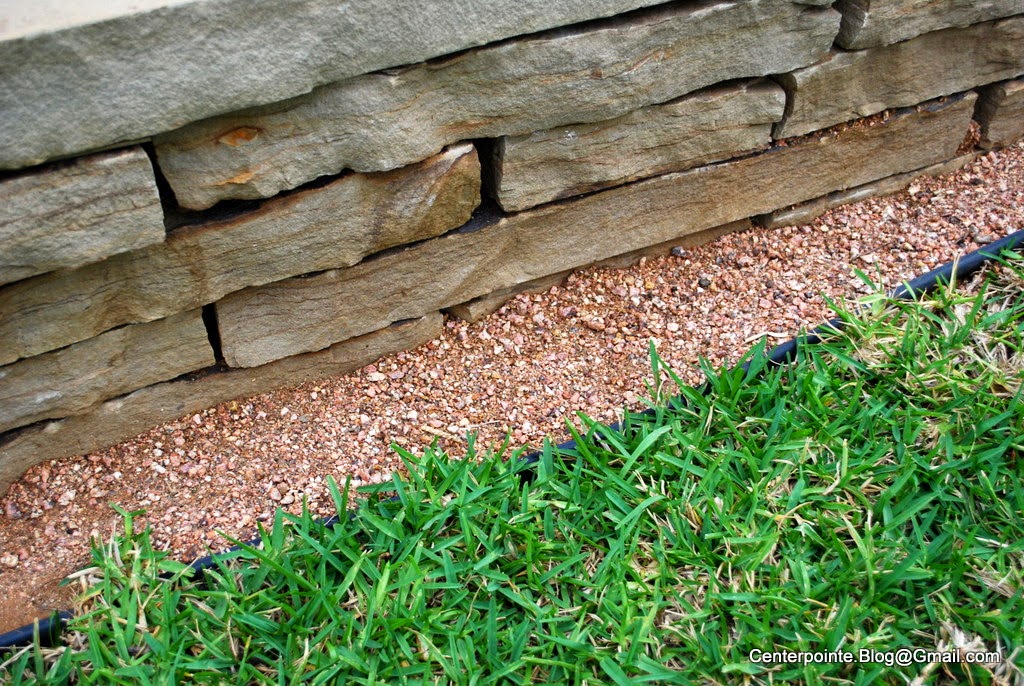
Notice the following:  (1) The crushed granite was added on top of the limestone within the generous footprint of the base, the footprint which extends out to either side of the rock which was wide to begin with.  This is all done with the intention of constructing as robust a base as practicable (given cost considerations) to minimize future shifting and settling.  (2) Pink twine was strung to keep the structure on level.  (3) Stone stacking started at the corner, which is a geometric necessity (you can't start anywhere else and have the corner come out properly).  (4) This is a dry-stack methodology.  There is no mortar placed between the stones. 
 Number (4) above is what I meant when I said I decided not to fight nature.  I expect soils in this area to shrink and swell and shift as the years pass, because that's what they do around here.  Instead of trying to oppose this, I decided just to create a robust base, but then if the soils shift in two or five or ten years, I'll simply disassemble this wall, re-level the base, and re-stack. 
 
To say the same thing another way, my principal investment is in the stones themselves.  If I were to mortar them together and then this whole apparatus shifts much like the Courthouse Annex's low brick wall did, I'm going to damage the stones, perhaps irreparably, taking them back apart.  If instead I leave this whole thing float, I'm preserving the bulk of my investment even if it requires future adjustment. 
 
My husband took this line of reasoning even one step further in noting with amusement that, if housing resale prices in Centerpointe soften to the point where we cannot get our stacked stone investment back upon selling this house at some future point, we could simply pay movers to pick up all this stone and take it to our next house, so we could re-stack it there. 
 
Now, on with the final bits of the description. 
 
The actual placement of the stones is an art.  This is natural stone, so it's not all the same thickness or shape.  It's basically a process of iteration to find the optimal configuration. 
 
Using pre-cast cement blocks is much more convenient because they're all identically sized (and also a lot cheaper), but we find it to be nowhere near as beautiful as natural stone.  Stacked stone in greater Houston - the ultimate luxury. 

I'm really happy that we decided to include crushed granite in the base like this (it was our landscaper's idea).  It adds another visual dimension, a meatier look, and it makes for an easier lawn-edging task here.  Crushed granite will become even more important in Part 2 of this post.   

BEFORE and AFTER:  "Builder basic" becomes bodacious.
In summary, the keys to this dry-stacking approach are as follows:
  1. The stone is wide enough and heavy enough to bear the weight of the soil in the bed behind it without needing to be physically fixed.  Narrower stone would not work without structural reinforcement. 
  2. The wall is low enough so that significant shear stress does not occur.
  3. The base is robust enough (hopefully) to minimize the effects of shifting.
  4. The stones are overlapped for optimal weight distribution.
  5. The stacked stone is plumb and level so that there are no lateral forcings that would exacerbate a shrink-swell-driven tendency for the entire unit to gravity-creep.  Remember what I said three or four times when describing how we built our cinder block cactus garden: whatever it is, build it level.  If you fail to do this, you can expect misery, and sooner rather than later. 
OK, so I know you're wondering:  What the heck did this latest suburban tract home escapade of ours cost?! 
 
Here's what went into the bill from Greenscapes Lawn and Landscape
  1. One pallet of this very expensive stacked Oklahoma sandstone 
  2. About a yard each of crushed granite and crushed limestone
  3. Transportation of all materials
  4. Labor (one day of work for the landscape supervisor and two apprentices)
For those of you who are regular blog readers:
YES, I tried to find an honest construction contractor who is operating above the law, including where tax payments are concerned.   Note the date on that invoice stub - April 29, 2013.  I signed that contract and paid this bill almost a month before I raised those potentially uncomfortable questions about the source of labor for the building of League City's new Public Safety Building.  I do actually try to put my money where my mouth is - in this case, literally. 
Greenscapes Lawn and Landscape is owned by a young man named Joe Cunningham.  He's from another part of America where construction business doesn't exactly take place like it does in Texas.  He told me that he's paying his taxes and I was inclined to believe him.
 
Could you get a stacked stone bed built around here for less than that amount shown above?  Almost certainly.  Could it be done for much less but still with equivalent construction care by an experienced professional who is actually declaring their income?  Please drop me an email if you find such a contractor. 
 
Anyway, now you know the secret as to why my husband and I are such consummate DIYers: if we limit ourselves to using legitimate contractors, we can't afford to do very much contracting.  Of the massive amount of customization work we've done on our house over the past three years, this was the very first time that we hired someone. 
 
In Part 2 of this post, I'll describe our second stacked stone bed, the supportive base for which my husband and I designed and executed ourselves, and which is different from the method shown above.  Stay tuned.