Friday, November 16, 2012

Walking wonderland, Part 2

Good grief, Galveston Central Appraisal District (CAD) is a pain in the lower anatomy sometimes.
This error message occurs frequently.  And it often persists for days at a time.  Screengrabbed from what should actually be http://www.galvestoncad.org/Appraisal/PublicAccess/.   
I wanted to provide some additional ideas on walking routes around here, but in order to do that, I first have to verify which parcels are owned by whom, to ensure that I'm not accidentally describing something that would have the potential to be a trespassing scenario.  And that verification can't be done with an apparently-crashed CAD server.  Again. 

Anyway, what I'll offer instead today are a few cool pics of our neighboring subdivision, Oaks of Clear Creek. 

It's that subdivision due east of Centerpointe, on the other side of the retention ponds and the easement.
Screengrabbed from Googlemaps.
This development is almost 20 years old, and land in League City was a heck of a lot cheaper back then.  What this means is that this subdivision ended up with a larger ratio of common area to single-family lots compared to what Centerpointe has. 
This subdivision can be accessed on foot via the Interurban easement which is just on the other side of our stormwater retention ponds.
There's a foot gate in the wrought-iron fence that surrounds the subdivision's common areas.  It's got collision posts to prevent any type of small motor vehicle (such as ATV) from passing through from the Interurban easement. 

In a previous post, I questioned the strict legality of walking in the Interurban easement (I don't know the answer to that), while at the same time noting that it's not posted and many local people walk there on a daily basis.  Furthermore, at least half of the easement-flanking properties in Oaks of Clear Creek were constructed with back fence gates allowing property egress directly into the easement, as was this community park.  There is substantial evidence suggesting that this was conceived as an area where the public would, in fact, walk. 
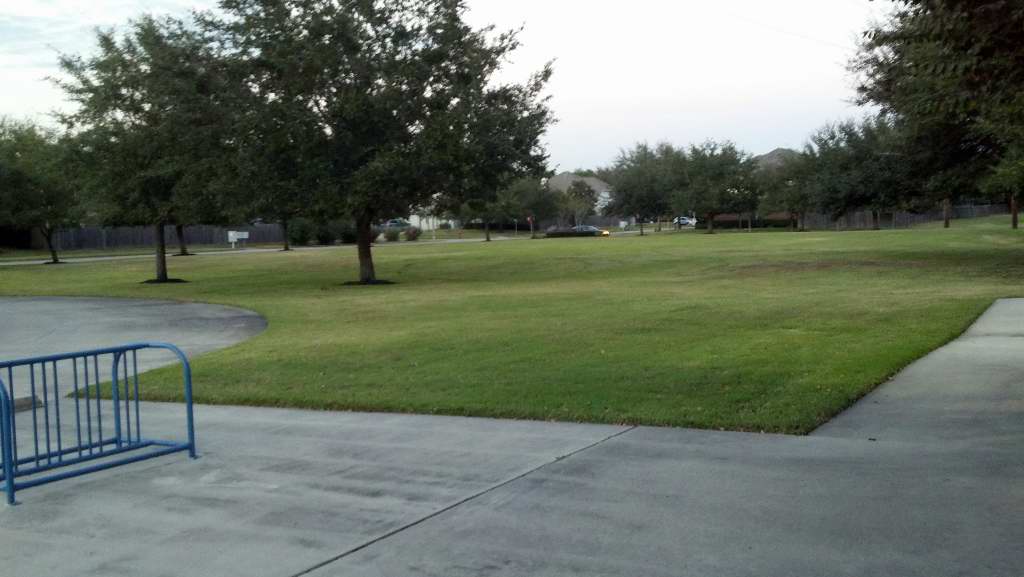
Thou shalt not covet thy neighbor's common areas?  Well, I do.  The pool and park areas are HUGE by present-day subdivision standards.  It's so cool to see open areas like this.  Kids can throw balls here and whatnot - there's enough space for that.  Unfortunately, we don't have this kind of resource in Centerpointe. 
They didn't call it the OAKS of Clear Creek for nothing.  I don't know who the developer was, but the number of shady oak trees in the park is just fantastic.  The subdivision is also unique in that some of its single family homes have water oaks in their front yards, instead of the usual live oaks (and there's a street in the subdivision named Water Oak).  Water oaks are native and grow quickly into absolutely massive, upright trees - they can reach 100 feet in height.   
Free rodent control for the surrounding homeowners!! 
Lucky them!!
I did notice that one of the park's playscapes seemed to have met with some kind of recent misfortune.  Vandalism?  Arson?  I don't know.  I didn't hear anything about this in the local news, but then again, I don't hear about a lot of local things that happen, in part because League City doesn't have its own newspaper yet. 
Back in April of this year, I described a public outreach initiative pertaining to a new pipeline installation that was scheduled.  Initially it was suspected that the pipeline would be in "our" Centerpointe easement, but in fact, it's probably due to be installed in the Centerpoint  easement, which we think is the Interurban easement. 

I haven't seen any physical activity to date regarding that, but unless plans have changed, there's a good chance that there will be some construction-related disruptions in this area in the future.
Until such time, if watching sunsets is your thing, there's hardly a better wide-open location than this.  This is the view last night, looking west across the fields toward Centerpointe.  You can see our iconic pine tree just left of photo center.   

Thursday, November 15, 2012

Fantastic free-range feature

A few thousand years ago, Greek mathematician Archimedes legendarily distinguished himself by running naked through the streets screaming something along the lines of, "Eureka! I found it!" following his bath-time realization that hydrostatic displacement could be used to determine the volume of an irregularly-shaped object such as a king's crown.

Whether or not there's any truth to this famous scientific anecdote, I felt much the same way yesterday after watching a reporting segment produced by our local ABC-TV affiliate KTRK, which I will embed at the end of this post.

Fortunately for y'all, I did not proceed naked through the neighborhood, but the fact remains that I found it:  An unusual example of responsible journalism, and an uncommonly introspective one at that. 

Let me explain in detail, because hell might freeze over before any of us have the privilege of seeing the likes of this again.

I raised a "free range" daughter, to the point where we were literally a local poster-family for the movement, widely known (and occasionally vilified) in our community, appearing briefly in a European TV documentary, and making other public appearances that I will not reference here.    

For those of you who are not familiar with this child-rearing approach, it's difficult to capture all the nuances and underlying philosophies in one easy sound bite, but the underpinnings boil down to this:

Kids are a lot safer today than our pathologically-suspicious and histrionic American culture is publicly representing.  And they're a lot more capable than we give them credit for.  If we grant them the types of appropriate freedoms that we grew up with when we were children, they will develop stronger situational awareness and self-regulation skills than they would if we were to simply overparent them into a psychological no-man's land. 

You've probably heard the term "helicopter parenting"?  Free-range parenting is, in many respects, the antithesis of that.  In my view, helicopter parenting is a subtle but gruesome form of child abuse because it communicates a wholesale lack of faith in the child's intrinsic capacity to mature.  It instills groundless fears and literally erodes a child's ability to develop his or her own distinct identity. 

Anyway, as I started to say, my child grew up free range in north Clear Lake.  From the age of about seven onward, she was allowed to go outdoors, meet up with a few friends who were also granted the same limited but logical freedoms, and explore our neighborhood without any adult hovering over her head in a state of sub-panicked paranoia.  And for several years, that's just what she did with her free time - she would leave our home with her friends on a weekend morning, and then re-appear perhaps six hours later, all smiles and sparkling eyes, to tell me about their collective adventures. 

I watched that small group of kids flourish in the face of these basic freedoms.  From afar, I saw them develop fantastic cooperation skills, such as subtle but highly-sophisticated intra-group communication protocols to warn of approaching cars as they were riding bikes and playing ball games in the streets.  They climbed trees unassisted.  The built a secret fort in the shrubbery behind one of the Pineloch neighborhood monument signs, a bower into which they would retreat for hours at a time.  They knew every squeezable hole in every fence within a half mile of our house.  Even if the Boogey Man had attempted to pursue them at any point, he wouldn't have had a chance.  They had mentally mapped their surroundings so thoroughly that they would have simply slipped away, vanished like four-foot phantoms, as the masters of their suburban environment that they had literally become. 

My daughter, now a teenager in high school and beginning to feel the inevitable performance pressures of impending adulthood, looks back upon that time with pure reverence.  "Those were the best years of my life," she often says, with a twinge of sadness in her voice, mourning their passage. 

I can't imagine what either of our lives would be like today had we not lived that way when she was young.  What's the point of living if there's no available access to life's everyday moments of pure magic?  How does a child go on to explore and relish the wider world and successfully face adult challenges if they start from way, way behind the existential eight-ball, cement-shoed with the type of abject fears and suspicious world views that are transmitted to them through helicopter parenting?  I don't know the answer.  I do know that, even as we were free-ranging, I was seeing some other children - a mere seven or eight years old - already beginning to take psychoactive medication to manage their anxiety and depression.  It's easy for me to understand why they were succumbing to those afflictions at such tender ages. 

Anyway, the great gift that KTRK gave us all yesterday was to shine a CG spotlight on the extent to which many helicopter-style fears are actually groundless.  Free-rangers have known this all along, of course, but in the chronically-sensationalist commercial news media, that part of the message is almost always sacrificed on the altar of "bad parenting" rhetoric and "if it bleeds, it leads" mentality. 

KTRK reporter Ilona Carson showcased quantitatively the relative risks posed by the "stranger danger" hysteria that is usually the excuse parents give for hovering and prohibiting unsupervised play. 
An American child's odds of dying in a car wreck are TWENTY TIMES HIGHER than their odds of being abducted by a stranger.  And yet which of those two possibilities dominates every child autonomy decision made by many parents?  The snatching scenario. 

Screengrab from KTRK.
This is obviously a disturbingly-poor risk assessment that many parents make, yet it's not difficult to understand what drives their mistaken priorities.  We are constantly surrounded by over-hyped media presentations of those few children who do become victims of this incredibly-rare type of crime (even when they are not really). 

But here's where KTRK's production progressed from important to revolutionary:  They actually shone the spotlight squarely on their own contribution to the problem by referring back to their coverage of a recent Houston abduction - the type of story that may work well where subscriber ratings and advertisement revenues are concerned, but which arguably does a disservice to our society by helping to distort public perception of the associated risks.  That took real guts. 

This wider risk prioritization issue, by the way, is also why I am so strident on certain public service priorities such as traffic enforcement, sidewalk availability and sidewalk maintenance.  There are risks posed to young children who are playing and exploring outdoors with a minimum of direct adult supervision, but they are not the risks that most parents assume.  The primary risk derives from the auto-pedestrian threat.  THAT is what we should be working to ameliorate, not the much-lower risks associated with imaginary Boogey Men. 

Anyway, thanks for slogging through my usual long-winded preamble.  When I immigrated to Houston many years ago, the first words I heard uttered were, "Say it out loud!  I'm Houston proud!"  I was never Houston-prouder than I was yesterday when I saw this news segment, and I give my heartfelt thanks to both Ilona and Lenore.  Enjoy the 3.5-minute show.

Wednesday, November 14, 2012

Eagle Ford echoes?

If you read the news these days, you can't escape the headlines declaring American energy independence to be within our reach (although some are skeptical about what it would mean or whether or not it's even possible). 

All this, of course, is due to advances in drilling technology coupled with high global oil prices, a synergistic pair of circumstances that have increased production - and employment - in a number of key areas nationally, including the nearby Eagle Ford shale, for which the increases in productivity have just been jaw-dropping. 

And then there's the curious case of the Webster Steak and Shake, which was recently constructed in fine franchise form, but then never opened.  It sits there not far from us (you can see it as you drive on NB IH-45 near the new NASA Road fly-over) like a virginal retail monument to... something we're not quite sure of. 

What could these two things possibly have in common?!

Well, there's a chance that they are all part of the same tightly-interconnected phenomenon that sent me hiking to no less than three different Clear Lake grocery stores last week in order to obtain the type of milk that I buy for my family (organic skim).
These days, I'm having more and more trouble with what should be one of the easiest jobs that any domestic goddess has to do.  Here's a shelf with one lone gallon sitting in the organic section - and this pic was taken before noon on a Sunday, so we can't blame this run-on-the-milk-bank on the lateness of the day.
This shows conditions in another local store just a few hours later:
None whatsoever.  I'm not trying to accuse any one g-store in particular here - this is happening with all of them.  I've greyed out identifying marks in these photos so as not to appear to be picking on any retail chain in particular. 
And it isn't just milk.  I'm often greeted with the same empty-shelf phenomenon when searching for my other favorite grocery products. 
I'm a great fan of this brand of granola bar because they are reasonably priced while at the same time lacking the usual low-nutritional-quality carbohydrate fillers that characterize so many other brands.  But finding them on the shelves?  Difficult. 
This scene may not look significant to you until you understand why it's only ONE lineage of this pomegranate juice that is missing here (and which is almost impossible to obtain locally, by the way).  The product that usually fills the gap to the left is the plain straight-up stuff - the pure pomegranate juice.  The others are diluted with other juices such as cherry or grape.  Pomegranate juice is extremely expensive but is widely believed to convey significant health benefits, so the consumers who spring for it are educated and not so dumb as to spend their money on a cut or watered-down version of the product, which is arguably what these other choices are. 
So how might this third issue, namely grocery scarcity, relate to Eagle Ford and Steak and Shake?
  • They might all reflect workforce availability which has been impacted by the lure of great jobs and good money in the revived Texas oilfield, both within the producing areas themselves, and in spin-off industries, of which Houston has a mother lode. 
  • It has been speculated that the Steak and Shake was built but then failed to open because the operators may be having difficulty finding the people they need to staff it. 
  • I suspect (but have no proof) that this lack of stocking across multiple grocery stores may also reflect significant staffing problems.  It does not matter what time of day I shop:  if I go early in the morning, the shelves are empty from the night before, and no staff can be seen actively stocking them.  If I go mid-day, a few stocking clerks can be seen in the store, but many shelves are still empty. I have not been able to identify any local store where I can pick a specific time of day or a day of week and consistently find product on the shelves. 
  •  Tellingly, I now tend to see staff working to stock shelves during peak grocery rush hours - which is extremely inconvenient as huge fork-lifted pallets of stock block grocery aisles and exacerbate shopper congestion in the stores.  I suspect this might be happening because the managers cannot find a sufficient number of staff who are willing to work the night shift, which is the time when most re-stocking traditionally occurred. 
And it's not just the products I've shown above for which these stocking shortages are happening.  Those are just the pictures that I happened to take in an isolated photographic effort about a week ago. 

There are shortages of other products as well, including certain meats, cheeses, and snack foods, but they all have one thing in common:  the products I've found to be missing (including the sub-set depicted above) are generally higher-quality, more nutritionally dense than the bulk of the factory-farmed, highly-processed, mass-produced big-brand alternatives that comprise the bulk of any given grocery store's offerings.  So there may be a two-fold issue manifesting here - an employment shortage PLUS the fact that the Clear Lake's healthiest consumer segment is chronically underserved in the marketplace to start with.

And we were painfully aware of that second part already, of course.  Several years ago when HEB Clear Lake Market opened to great pomp and ceremony, I attended a "grand opening" meet-and-greet that was held by their corporate management staff (not the store management - the higher-ups).  I spoke to this one important-looking lady in particular and asked the following question:

"It's great that you've moved into this new space, but why, why, why didn't you make it into a Central Market instead of into an ordinary HEB store?!?!"

She looked at me with this grin that was both cheery and absolutely dismissive and replied,

"Our market research indicates that this is not a health-conscious community."

I was completely stunned.  Struck dumb.  I was so shocked by the directness and decisiveness and lack of political-correctness of her reply that I couldn't even muster a feeble rebuttal.  I simply wobbled away like a cartoon character whose head had just been clashed between two cymbals.

I couldn't find an example cartoon showing my beloved Bugs Bunny, so here's a low-res partial screengrab from this site.
I quoted her exactly there.  I know this because her choice of words reverberates within my head to this very day. 

I'm not sure how this conclusion was reached.  Here in "greater Clear Lake" we have a highly educated population concentrated largely in the medical, petrochemical, and space sciences industries, and yet what falls out of who-knows-what formulaic analysis is this notion that our scientifically-apprised residents prefer to stuff their collective faces with cheese puffs and the like. 

Meanwhile, local competition for nutritionally-dense alternatives is becoming downright ridiculous.  I know what health-conscious people have started to do, because I've started to do it myself:  once you locate a desired product that is actually in stock, you simply buy out the entire shelf, because you know it's not going to be there on your next trip to the store.  But this, of course, makes things worse for everyone else who is attempting to buy normal weekly quantities of those same products.

So on every recent occasion where I've gone shopping only to be greeted by this particular comestible consumer vacuum, I have muttered under my breath, "D*mn the Eagle Ford, anyway, for doing this to local labor supply!" but grocery stocking labor is probably only part of the supply and demand equation here.

At any rate, if this were our worst problem in life, we'd have to declare ourselves to be in pretty fine shape.  Still, I look forward to a future when we have better access to the healthier alternatives that so many of us obviously demand. 
Some people hear this message from their doctors.
The rest of us simply use common sense, and we try to grocery shop accordingly, with only limited success.
(Microsoft clip art.)

Monday, November 12, 2012

Trash cash: How much could we save?

In the "never get sick of beating a dead horse" post category, and following far more detailed posts (plural, and plural) on the same subject, I thought I'd expand my trash argument by pulling in just a few more general quantitatives. 

Why do this??  Because all of the logical arguments in the world fall short of a headline home-run if we haven't got a number to associate with potentially re-vamping the League City trash contract.  How much cold hard cash could we potentially save??  That is the bottom line we need to know and the exact sound bite everyone needs to hear. 
Is that really a bag of trash sitting beside that blue can?
Or is it actually a bag of money??
Microsoft Office clip art.
So if folks can temporarily set aside the escalating fear and loathing they feel for the federal government and allow me to use a general federal reference on these costs, here's what falls out.

First, may I please allow the federal government to state the obvious by my reproduction of the following quote from that publication:

In spite of the perceived need for twice-per-week collection, studies repeatedly demonstrate that the second collection day is underutilized. 

Translation:  people are simply not using the service.  Feel free to tell folks that you heard it here first.
"especially the South"? 
Like we're a bunch of sun-baked dumb-a**es who are the last to figure this stuff out??
But wait - it gets even better.  Here is another quote:


Keeping Customers Satisfied:  After a 6-month pilot program in Plano, Texas, 92 percent of survey respondents agreed they did not need a second MSW collection day each week. 


Plano's a city with some of the same Texas metroplex bedroom-community character as League City.  If Plano managed to muster enough common sense to snap to this realization, do you think it could possibly be within reach of League City as well??

Anyway, let me curtail the obvious idealogical tangent and proceed with the rudimentary cost analysis.
This is a general cost breakdown graph.
Let us accept at face value that 50% of the costs are incurred during the act of collecting the trash. 
Screengrabbed from this reference.

20121113 POST UPDATE:  I just noticed that this reference is from 1995, when diesel was about $1.10 per gallon, versus $3.28 per gallon as of today.  That makes the cost estimate below VERY conservative, as collection costs must have risen substantially with a tripling of fuel prices.   
Couple that with this bit:


Twenty to forty percent reduction in vehicle and labor costs?  Let's be conservative here and assume that going to a once-per-week scheme would eliminate 30% (i.e., the midpoint of that range) of that 50% collection cost factor.  Viewed roughly this way, going to once per week collection in League City would therefore be expected to result in a $4.5 MILLION savings for the League City taxpayers over the life of this next contract ($30 million current contract value times 50% associated with collection times 30% reduction). 

There's your sound bite number, crudely estimated, but somebody had to do it.

What could we instead buy with four and a half million bucks that would actually furnish lasting value to the city? 
Screengrabbed from the same reference.
If anyone has a better savings estimate, please produce it, because this is important.  Ameriwaste is perhaps the entity most suited to putting a really fine point on that savings number, and I'm saying this not because I want them to receive a new contract but simply because they arguably are in possession of the mother lode of institutional knowledge right now.  And you should never underestimate the goldmine of potential that resides within institutional knowledge. 

Oh, but wait.  If we got our chosen vendor to supply lidded recyclers similar to the one I gussied up with spray paint for my own family, we could similarly cut recycling collection costs by a substantial amount because those lidded things hold far, far more volume.  So this $4.5 million is not nearly the limit of what could potentially be saved.  That actual dollar figure could be significantly higher. 
These things.  They hold so much more than those goofy small bins that we could easily go to a bi-weekly collection scheme if we had them, just like Houston does. 
So additional cost estimates are eagerly welcome here.  I'd really like to see this post be part of the beginning of the wider dialog, not the end. 
They turned out to be money bags afterall.
 

The state of the League City blogosphere

A long time ago and even recently, I mentioned that it was never my intention to make Centerpointe Communicator into an "issues" blog.  I had intended to preserve this as a "lifestyle" blog, my personal Suzy Homemaker-style recreational outlet to counterbalance my otherwise-serious and technically-oriented lifestyle as a parent and micro-business owner. 
Every once in a while I'd like to kick back and forget about all those years I spent studying rocket science in graduate school and instead focus on the boundless enrichment that mindless television can contribute to my life.  In the process of blogging, I have ended up availing myself of tear-jerker style indulgences, alright, but they weren't the type I initially anticipated.
The trouble with my initial plan was as follows:  I began to get increasingly concerned with what's happening in League City on administrative as well as political levels, AND, to my knowledge at least, very few others seemed to be making much of an effort to bring those issues into the public view. 

Or if they did push those issues into view, out of necessity, it was largely restricted to mainstream reporting.   Galveston County Daily News generally does their job very well, but they are a commercial news outlet and they have to act as such if they are to survive in the market.  They are also spread thinly and are routinely forced to focus on the bizarre antics that plague other cities that also fall within their coverage area, such as La Marque, and (holy crap - what next!!) City of Galveston.  Much the same restrictions can be seen to characterize the reporting depths achieved by the geographically-distant Houston Chronicle (example here). 

My husband moans about the fact that League City has experienced all this explosive growth and yet hasn't managed to give birth to its own newspaper yet.  Maybe some day that will change, but I'm not holding my breath, especially in light of what's happened to commercial journalism over the past few years. 
How big does a city have to get before it can support its own newspaper?  Does anyone know the answer to this?
Graph screengrabbed from this site.
Far more deleterious than the naturally-limited commercial news media are the entities who are augmenting the newspapers' efforts with non-commercial public commentary mostly because they are focused on personal gain, not because they are primarily concerned with objective facts, the rights of the taxpayer, or the future of League City. 
  • Such is the case with every real estate blogger in and around this city, the ones who blog only as thinly-veiled attempts to increase the size of their own contact databases.  These are not bloggers - they are marketers.
  • Such is the case with everybody else who is engaged in direct selling of goods and services.  They are exploiting a free platform in an attempt to raise their own profiles, and they are clogging up the search engines with worthless content in the process.  Every time I start trolling around to check up on who's-who in blogging these days, I have to waste valuable time sorting through all of their useless self-promotional spew.   
  • Such is also the case with certain political special interest groups whose efforts I'm not even going to dignify by referencing active URLs.  Their blogging amounts to blatant self-advocacy for the obvious greedy reasons. 
There are, however, a number of additional individuals and social consortia for whom the citizen-journalism integrity issues have never been as black and white as all that. 

The people in this category are perhaps leaving the door open to some kind of a longer-term personal advantage in terms of political gain and/or a specific market share, yet at the same time, they are clearly justifying their own existences in the blogosphere by providing valid observations, viewpoints, and raising very good questions, as well as furnishing factual content that is genuinely of interest to many of the folks who care about League City.  These are people whom I don't know and might not agree with, but they do have valid things to say, and I definitely want to hear those things. 

Back in 2009, former (?) Chron writer / League City reporter Thayer Evans produced a little piece titled "Dueling blogs in League City" which neatly summarized the guts and history of some of the players who fall into that category.  Thayer focused primarily on Mallios and Edelman and the friction between the two.

But that was three years ago, and since that time, things in the blogosphere have continued to evolve.  As a citizen journalist who is aligned with absolutely nobody in any political or commercial sense, I'm only partly apprised of how and why they are evolving, but here below is what I can report about it as of today. 

My concern for the state of information availability began to escalate earlier this year because Mallios appeared to cease production of The League City Blog.  As of today, its most recent post is from July 2012 - four months ago.  This cessation was particularly unfortunate given that it was occurring in a pivotal political season, and the disappearance of this collective voice was one of the reasons why I stepped up my own process of blogservation and commentary.  League City is a big city with a controversial political profile and somebody should be making an ongoing attempt (however limited) to journalistically mind this store. 

Following that apparent summer cessation, what concerned me even more was Mallios's unabashed open love letter to Tim Paulissen in GCDN in October.   When I first read it, my exact reaction was, "What the hell was that?!"   Bear in mind that I'm a complete political Newbie here, and a reluctant one at that, but I have no idea why GCDN would want to publish that as anything other than a clearly-marked op-ed.  Someone please explain this to me if you think it would be worth your effort and my time to cover it.  I have no issue with personal loyalties, but when they are played out in that format, of course it calls into question a lot of wider objectivity issues. 
Please, not in the commercial press!
At least, not without being appropriately captioned.
So basically, I was increasingly concerned that a disturbing journalistic vacuum may have begun opening up here, and initially I did not understand why.  But this question got partially answered within the past couple of days when it came to my attention that Edelman et al. re-commenced blogging under the title Real Scary League City Politics about six weeks ago.  I guess I didn't get the memo on that, and being a nascent site, it hadn't had a chance to rise high enough in hits to enter the general public's radar. 

Anyway, here's where I stand on protocol as we move forward in our inextricably-intertwined and arguably-underserved commercial and citizen journalism universes: 

I'm attentively reading, referencing, and blogrolling (and occasionally commenting on) anyone in League City, Clear Lake, or Galveston County whom I feel has something worthwhile to say about any relevant local topic, even if it can be argued that they're partially driven by their own interests (e.g., Edelman is aligned with former Councilman Cones who still appears to have a strong interest in muni affairs), and even if I don't agree with them on many issues. 

The purpose of the blogging medium is exchange of information and genuine dialog.  Everybody should have the opportunity to be exposed to what everyone else has to say, to at least be informed about the range of other viewpoints out there. 

I'm glad (and relieved) to see that this new blog has initiated, for this reason.  My husband and I both have good jobs and neither of us have the time, interest, or ambition to make extensive contributions to the League City political scene at this point in our lives.  But every time I read stories like this and this and this, I just cringe and then I feel compelled to do something about it, as any responsible citizen would.  Administrative continuity is absolutely vital for the success of a city like League City, especially technical continuity.  Without a threshold level of stability and continuity, institutional knowledge gets lost, sometimes to the point where astonishingly bad (and expensive) mistakes can happen.  Such as a city spending over a million dollars on a water treatment facility without ever getting it working, and then only discovering the oversight when the city's water pressure starts failing in the depths of drought.  The likes of that is downright horrifying and would compel anyone to make a contribution toward remediating the obvious municipal dysfunction. 

Blog on.  All available voices are needed to help keep tabs on a fairly big city that continues to be characterized by a fairly small amount of news reporting.  And if any additional new blogs pop up, please, someone drop me a line. 

Sunday, November 11, 2012

Last weekend's arts festival at Butler Longhorn Museum

Having recently exhausted myself with municipal mayhem, I thought I'd counterbalance with someting a little bit more light (at least I try to end this post that way).

Did you happen to notice the bandit signs around League City last weekend?  They were advertising this arts festival at Butler Longhorn Museum. 
These.
Let's take a closer look at that...
Classic example "bandit sign".  The legality of these things is questionable, especially because League City Parkway is technically a TxDOT roadway, and state law prohibits certain signs from being placed like this, but I don't know the specifics of what's allowed or not allowed.

Anyway, I'm not necessarily opposed to signs that are placed temporarily to convey information that may be in the public interest, which arguably this might have been.  I mean, it's not just another in an endless stream of snake oil salesmens' weight-loss advertisements. 
I'd really like to see more events along these lines come to League City so that it becomes more of a proverbial destination instead of a "place people drive through on their way to [spending their money] somewhere else".  It's actually been described that way in the press, but internet content shelf-life being what it is (i.e., gone in the blink of an eye in many cases), I haven't found any of the original URLs where it was stated that way. 

However, there certainly are some practical challenges involved with this lofty League-City-as-destination goal, specifically because we as a city are so lacking in basic infrastructure.
This is what Coryell Street looked like during that arts festival.  I had originally planned to attend, but upon seeing the traffic mess and lack of parking, I gave up on the idea - too much hassle.  I love, love, love art festivals of all kinds.  I routinely spend money on art, especially when the sale of it has a local conection of some kind.  But it defeats the point of the participation experience if there are road blocks (quasi-pun intended) standing between it and myself.  Seeing the mess on Coryell, I decided to wait for the next Bayou City Art Festival instead. 
And of course the problem with hosting an event of this type at Heritage Park is, not only can you not park there, you can't safely walk there either.  It's simply unpleasant and anxiety-provoking to have to share the road with motor vehicles, as this brave dog-walker is doing here on Wisconsin Avenue, about a block southwest of the Butler Longhorn Museum.

Obviously if there's no room to even walk here, there's no room for parking on the non-existent shoulder, either. 
Let me state the obvious once again here.  This will sound broken-record-ish for those of you who are regular readers of this blog, but we have new City Council members who were elected on what appears to be platforms of fiscal conservatism - but as the old saying rightfully goes, you have to spend money to make money, and League City needs to carefully spend money on infrastructure if it wants to realize real economic gains along the "destination" line.  So it's worth re-articulating this kind of thing. 

For the record, we should review the reasons why many recreation-seekers exit the freeway at FM 518 and drive straight through League City on their way to Kemah.  They do that because they can friggin' park in Kemah.  And then after they've parked, they can step out of their cars and actually walk around without fear of getting mowed down by motor vehicles. 

I have a young teenager who, along with her buddies, has not exhausted her delight for the boardwalk's attractions.  I drive down to Kemah more times than I care to admit, and although traffic routinely escalates into annoying outright grid-lock, I never have trouble accomodating our transit and parking needs.  The place was designed to serve people, in other words.

Heritage Park is a neat little park and a great place to take children of all ages.  I know this from experience because we used to live quite close to it before moving to Centerpointe.  It is most unfortunately situated in the shadow of a hulking sewage treatment plant which basically equals it in the size of its footprint...
The park is contained within the roughly square patch at photo right, the tract of land with the winding walking paths.  Those circular things to photo left are sewage clarifiers.  The rectangular things next to the circular things appear to be sewage aeration basins.  This is the Dallas Salmon Waste Water Treatment Plant, and in years past, it racked up an unacceptable number of odor complaints from nearby residents (if you'd like to see the extensive list, you can go to this site and enter Dallas Salmon in the Regulated Entity Name search box).  However, since about 2009, the frequency of formally-registered complaints has declined, and so the plant's operators may have finally gotten a handle on what it takes to run this facility with a greater degree of effectiveness.  Thus it may not be having as much of a deleterious impact on the Heritage Park visitation experience as it once did. 
So do visit Heritage Park when you get a chance - just be careful about trying to access it whenever there's a special event going on. 

And when you go, do make sure that you visit with the turtles!!  The turtles are our favorite part, and are most easily visited from the pavillion-slash-gazebo that is built on that little island in the park pond.  Got grandkids?  If so, this is the place to take them - and it won't cost you a dime!  Here are some candids of the turtles as they were when we stopped by to visit them about a month ago.
"Here I am!  Don't let all that clinging algae fool you!  I'm really a sharp fellow!  A rolling stone may gather no moss, but the same cannot be said for turtles!"
"Here I am, too!  Party's on!"
"And collectively, we would do just about anything for a little nibble of that granola bar you are carrying!"
And with that I say, happy park-ing, of a sort. 

Friday, November 9, 2012

Turning trash into treasure: An open letter on the League City trash contract

Last night, City Council held its first of two public meetings to receive input on the new trash contract that City Council approved by a narrow margin (4 to 3) during the October 23 meeting. 

The meeting was intended as a forum for the airing of views regarding cost allocations between commercial and residential customers, as the new contract incorporates substantial increases that must be absorbed by someone.

But those views were not primarily what got heard last night.  What happened instead is that a clearer picture began to emerge regarding the very basis of the contract, which may have been flawed in more ways than I first realized.

I have argued (and argued) that the contract is over-scoped: it provides a greater intensity of service than is invoked by the needs of our collective residential and commercial situations.

Increasingly it appears, however, that the contract might also be over-funded:  the unit bases for the bidding may not reflect the reality of what actually exists.  This possibility became increasingly apparent as Ameriwaste representatives argued at length that, when viewed in real terms, they were not exactly guilty of proposing the bid increase of which they have been accused (to the point of losing the contract to another vendor). 

If you've never sat in on a City Council meeting before, I highly, highly recommend that you do it at least once (or watch at least one segment of the City's video feed, which is perhaps more convenient).

IF you do that, you will never again find yourself in a position of staring at a polling station screen and scratching your head in confusion over which candidates to vote for.  I sat there last night in that meeting marveling at the sheer diversity of personality and public service priorities exhibited by the individual members of that Council.  It's hard to believe that such a large range in basic perceptual skills and ideology could be found within a single biological species, let alone a single City Council.
:-) 

On one hand last night, there was Phalen and Mann, whose sole focus was propriety - specifically, whether or not the contract had been executed in accordance with laws governing municipal contracting. 

On the other hand, there was Becker and OKeeffe, whose sole focus was whether or not the contract represented a good value for the taxpayer, and who were summarily unimpressed by whatever degree of T-crossing and I-dotting might have been achieved during the mechanical execution of it. 

This wasn't stated explicitly, but I got the feeling that the whole thing boiled down to an argument between relative value and absolute value.  The four members of Council who voted FOR the new contract with Republic Waste two weeks ago were primarily concerned with how the numbers stacked up relative to what other local cities were paying for similar services.  And from that limited perspective, the contract looks pretty good, which I suspect is why they pushed so hard to approve it quickly and without further debate (and I don't mean to pin the blame for that on Phalen and Mann alone - Dawson and Lee appear to also have been characterized by that kind of thinking).  Their bottom line was that the lowest bidder was selected through a legal process.  That being the proven case, who cares about the rest?  Let's not sweat the small stuff, because League City has bigger fish to fry (Mann was particularly strident on this point last night).

I'll tell you who cares about the rest:  Any true fiscal conservative.  The issue of absolute value should not be dismissed out of hand without scrutiny, because it does not matter how "legal" a given contract is if the contract doesn't represent the best interest of the taxpayers to start with.  And "small stuff" in this case could amount to anywhere between a few hundred thousand dollars to millions and millions of dollars, depending on the lens through which one chooses to view the underlying assumptions that got crafted into the thing.

I don't have any personal political aspirations, so I can enjoy the luxury of being both blunt and potentially unpopular with what I say.  With that in mind, here are my recommendations for Council (with an 'i') as they go forward with this issue:
  1. Meet with Counsel (with an 'e') in a closed-door session as he indicated would be necessary to discuss contract severance ramifications.  You first need to know the number (i.e., the financial penalty) that would be associated with breaking the contract at any given future point in time.    
  2. Conduct the simple studies that I have advocated and set an example for:  take a quantitative look at how the good people of League City are actually availing themselves of the services procured under the existing trash contract.  Do the prevailing usages justify the scheme that was floated with no service refinements for the new contract? 
  • If the answer to #2 is yes, no foul - continue under the new contract as designed.
  • If the answer to #2 is no, do the math: compare the legal costs of breaking the new contract with the cost savings that would be realized by scrapping it and re-scoping it for a new bid round.  That basic arithmetic will tell you everything you need to know about how to proceed from that point.  (And you would not have to worry about service disruptions while this was playing out because Ameriwaste committed to an extension on their existing contract if the situation requires it.) 
I realize that there's a massive political component entrained in all of this, but I don't see how this kind of approach could be politically damaging - in fact, I think the opposite would be the case.  Suppose you guys did a study of trash disposal usage and found, as I did, that there is very little usage occurring on the second of a 2-day-per-week scheme.  If you eliminated the second collection day, yes, you would have some taxpayers screaming bloody murder in the commercial press about "service reductions" (probably a vocal bunch, but a decided minority).  But simultaneously, you would be armed with the world's strongest rebuttal:  "Listen, we did the studies, and we identified significant government waste within the existing scheme.  Too many people are simply not availing themselves of their second weekly trash day and this is costing extra millions of dollars for no good reason.  It is our mandate to prevent the waste of taxpayers' money.  That's the job you elected us to do, that's what we ARE doing, and here are the numbers to PROVE it..."

Not only would this not be politically damaging, I think it would actually be expedient when presented within that kind of perceptual framework.  To me, the whole thing is self-evident.

And regardless of how you move forward with these present contractual issues, please remember these iconic photos below (as iconic as trash photos could possibly aspire be) from my main post on this issue: 

This is the likes of what the good people of League City have been asked to pay for without ever being directly consulted.  These are just a few of the un-compelling reasons why we're paying for trash trucks to be sent around more than once a week.  We're paying for a contractor to pick up tiny bags of almost-nothingness a mere three to four days earlier than they would be picked up under a once-per-week scheme.  At some future point, as cost burdens continue to rise and as people intensify their demands for fiscal responsibility, you will be forced to evaluate the sanity of this practice.

Good luck to you all. 
"IIIII ain't got nobody..."
"Nobody... Nobody cares for me...."
"IIIIIIIIII'm so sad and lonely!
Sad and lonely!
Sad and lonely!
Nobody cares about ME."