Short Answer: Keep every dry good in glass or very heavy plastic containers. Absolutely everything, no matter how small the quantity, if you're planning to store it for longer than about a week or two. Make exceptions to this rule at your own peril.
Long Explanation: Ah, the pleasures of maintaining a kitchen pantry full of organic and exotic foods and spices. I buy a large amounts of both organic and imported dry goods for my family, and both are prone to infestations. There's a reason why so many pesticides are used in conventional agriculture - and the reason is insect control. But I myself would rather deal with insects than with chemicals, so this is how I manage the issue.
Dry goods don't usually come in glass or plastic containers, so you need to remove the contents from their bag or box as soon as you get them home from the store, and keep them in your own bug-proof containers instead.
Does your pasta come in a cardboard box or thin plastic wrap? Forget that. That's a red-carpet invitation to insects.
Repackage dry pasta into glass or plastic bottles. You don't have to spend a lot of money on the bottles. I wash out spaghetti sauce jars and large stew jars and use them for the job.
If you store a lot of dry goods, it's not if you will get an insect outbreak - it's when. But if you have everything in glass, it will be restricted to just one container when it does occur. I prefer glass over plastic because of the transparency - I can see insect problems in the earliest stages of development and nip them in the bud.
Repackaging in glass also has the advantage of showing you just what food products are your biggest offenders. If you wait until an infestation is underway to respond to it, then you won't know whether your rice infected your pasta, or your pasta infected your rice.
I use locally-grown Texmati rice where I can, but for some dishes including the biryani I talked about in this post, I haven't found a substitute for true imported Asian basmati rice.
I have never, not once, had an outbreak in Texmati in all the years I have used it, but Asian basmati is a different story.
Ewww.... the contents of this container are now destined for my compost pile.
I know that the basmati is the offending insect source because it has been sealed in this air-tight glass jar since the day I brought it home. These guys hatched out a few months after purchase (white rice keeps for up to a year).
With respect to rice, heating it at low temperature in the oven and freezing it for a few days is said to take care of the problem of any viable insect eggs remaining in the product when you buy it. I'm currently experimenting with both of those methods and I'll let you know what I find out.
I mentioned organic and imported foods as being potential sources of problems, but my glass storage strategy has revealed that there are certain conventional domestic American food products that also pose a high risk of bringing insects into my pantry.
Those popular seafood spice bags that you toss into your big pot of boiling water before you add your shrimp or crabs?? Bad news. The spice blends are encased in a loose mesh bag which, in turn, is stuffed into a small cardboard box. Those things are totally permeable to insects and, in my experience, are among the worst offenders. As soon as I get one home from the grocery store, I take the sack out of the cardboard box and put it into an air-tight glass container so I can see if problems develop before I use it.
As a matter of fact, every single one of my spices is stored in a glass container, regardless of brand. I have found that spices in general are among the worst offenders for spawning insect outbreaks, no matter what the source (foreign or domestic). And if you keep your spices in the factory-packed small skinny bottles with the labels plastered all over the front, you might not be able to spot the insects until the moment arrives when you're shaking the container over your cooking. No bueno.
I turned these spice racks into a contemporary art piece which defines our dining area wall. I'm going to get emails asking, "WOW, those are the coolest spice racks ever... where can I buy some?!" Sorry guys. Those racks were custom made for me by a friend who is a woodworking hobbyist. And the jars are surplus laboratory-grade containers with Teflon-lined lids. There's nothing even remotely like this for sale on the American consumer market. Not that I know of, anyway.
Let me emphasize again that it's not just dry good packaged in cardboard that is the problem. Thin plastic is also vulnerable.
You are often safe with heavy plastic wraps, but most packaged food wraps are not heavy, and insects can cut through thin wraps without a problem. Here we see an organic bag of breakfast cereal with a tell-tale hole. Given that the flap is pushed outward, the forensic analysis suggests that this was made by a bug who was emerging from the organic cereal, rather than one going into the cereal.
It's because I needed to improve my visibility in order to spot uninvited house guests of the kind that have six legs. So now I have shelves and sub-shelves set less than six inches apart, and a whole lotta stuff repackaged into my own glass jars. The little buggers can't hide from me now.
Answer: I haven't found a solution to this problem, but read on so that you can understand this issue fully.
My husband has been hard at work with the bait battles, obviously. This was the juvenile who greeted me when I stepped into our garage this morning. She could not have been dead for very long, but our battle won't end with her. She probably has 29 brothers and sisters waiting in the wings.
If you read up on the subject of rats and garages, probably what you'll find is a lot of useless information that tells you to ensure that the rubber seal on the bottom of the door is intact and tight against the ground. But the problem is rarely with the bottom of the garage door. The problem is with the corners.
The unfortunate light of day:
The door seal is just fine - but by design, it stops about an inch short of the side of the frame. That creates this gap below the guide wheel that holds the door in the track.
This opening is HUGE to any rodent. You might as well send them gold-embossed invitations to come live with you.
Several months back, I scoured the internet searching for some kind of product or retrofit that would seal these very obvious points of entry. I came up empty-handed, so it seems that I'm going to have to invent something to do the job. It's a tricky proposition because obviously the door is a moving part that can't be interfered with, and there's no fixed infrastructure in a convenient location for attaching any kind of a guard, because the wheel and its bracket are obstructing the area of concern. We have two garage doors so this means four corners, and I have a feeling that I'm going to have to custom-cut and bolt four individual barriers.
Sounds like a fabulous way to spend a Saturday, doesn't it? I'll post on the outcome of that job when I get it done. Given the strong cold front we just had here in Houston, the one that motivated rodents to seek even more indoor shelter than they usually would, my date with door destiny might come sooner than later.
My guess is that it's a specific error code, some kind of a subroutine built into this fixture to signal a short circuit, although I haven't tried to research it yet. There's nothing like four inches of rain to really p*ss off the fire ants, and immediately after this started happening, I discovered that they had invaded the exterior wall right below this light. Furthermore, we noticed that have been unable to reset a GFCI that ties into this wall (different circuit, same location). I've never seen fire ants trash a motion light before, but with ants, there's a first time for everything.
In case you need some background on this undesirable phenomenon, TAMU has a publication called "It's shocking what fire ants can do to electrical equipment". Looks like my husband has his honey-do all laid out for his Sunday afternoon. Bzzzzt.
Obviously it didn't end well for that critter in his lizardly jaws, but what is that??
Ummm, did this kindred spirit blogger mention the word hate??
Screengrabbed from An Austin Homestead blog. (This is actually just one of numerous "stink" insect species that are found on the upper Texas coast.)
The words "stink bug" inspire in outdoorsy Houstonians a visceral reaction quite similar to "invasive South American fire ants". Austinites too, obviously. They are a stinking pain in the butt, and given that I garden organically, anoles are my main line of defense against them.
This was quite the riveting transaction to witness:
Anoles don't understand English and they're not the sharpest knives in the drawer, either. I kept telling him, "Dude, you'd be having an easier time with that if you weren't also fighting gravity in the process." But he didn't take the hint.
Of course the whole time this epic swallowing thing was going on, the stink bug was fighting him big time. The scene reminded me of yet another Star Trek dialog, given that I'm into quoting Star Trek these days:
Gagh and stink bugs are always best when served live? Maybe, but they both trigger the obligatory gag(h) reflexes, apparently (a little onomatopoeia never hurt anybody). Have you ever seen a lizard gag before? You have now!
Finally a successful swallow, but God, that's gotta hurt.
After careful consideration, I abandoned my plans to petition the state of Texas to declare the anole to be the new state reptile. For one thing, having a Carolina anole as the state reptile of Texas just doesn't have a nice ring to it.
For another thing, anoles aren't compelling candidates in the distributional sense. The official state reptile, which is the Texas horned lizard, is fairly specific to Texas.
Texas horned lizard range map above screengrabbed from this site.
So the Texas horned lizard doesn't eat stink bugs - I guess we can live with that. I'll just have to continue putting up anole fan pages.
One species' meat is another's poison. But today I have one less gagh in my garden, and that's a good thing.
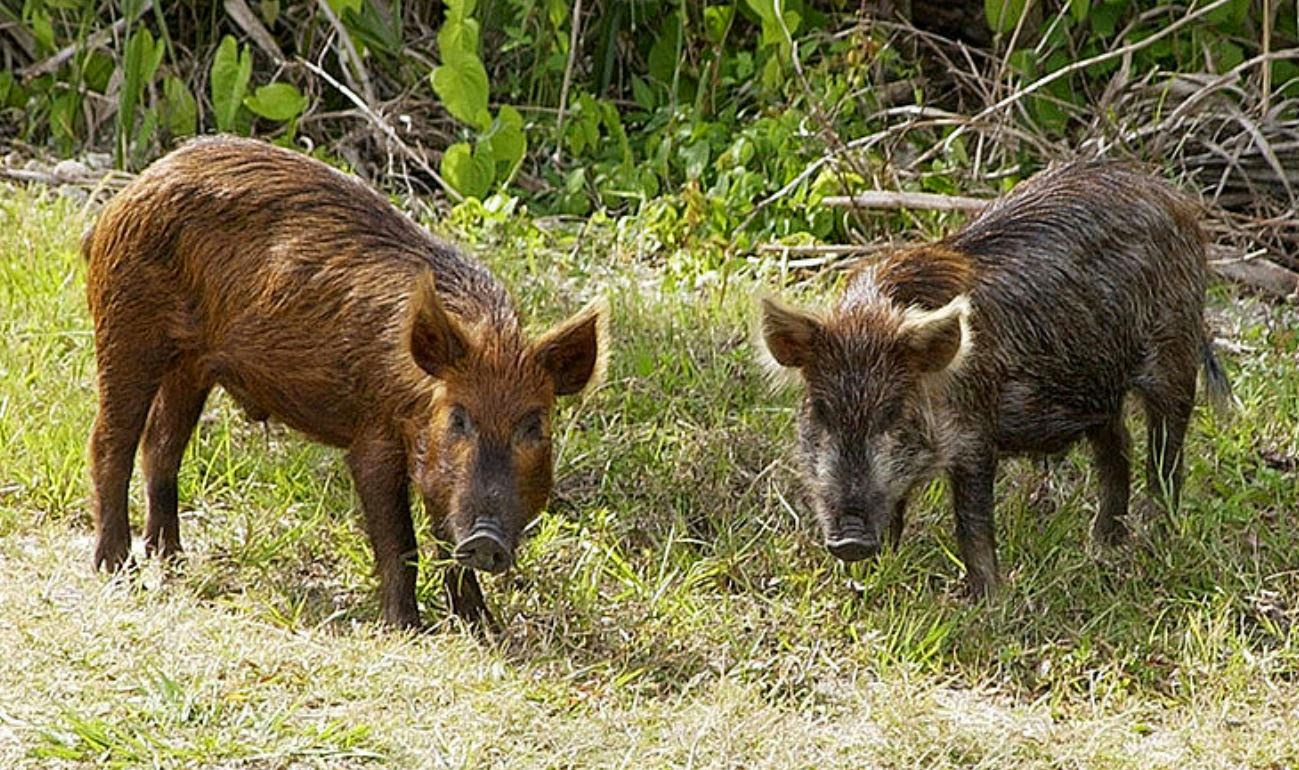
...and I've wondered why not. A few days ago, Galveston County Daily News posted a story about the ever-increasing problem of feral hogs in Texas, and while I've seen feral hogs just about everywhere else around greater Houston, I haven't seen them anywhere in north Galveston County. And I've wondered why not.
Feral hogs are domesticated pigs that got loose and reverted to a wild state. They are an enormous problem in Texas and only getting worse.
South Galveston County, absolutely yes, I've seen them there. Twenty years ago, the intensity of feral hog damage on Pelican Island had to be seen to be believed. Large swaths of soil turned over as if by a factory-farm-grade roto-tiller. At the time, I remember wondering where on earth they could possibly be hiding during daylight hours (they're nocturnal), because there really wasn't much on Pelican Island in the way of high scrub or forestation.
And they are well-established on the north side of Clear Lake. Let me give you a vivid example. About ten years ago, a huge engineering mistake was made on the extension of Space Center Boulevard from Clear Lake City Boulevard to Genoa Red Bluff.
I'm screengrabbing from this Chron article because it's so old that it will surely fall victim to link rot before too much longer.
Basically what happened is that they screwed up and built Space Center Boulevard at an unacceptably-low elevation. They had to go back and rip the entire thing up, raise it, and re-lay it.
Consummate Clear Laker that I am, I still have a souvenir chunk of the original Space Center Boulevard, not the one that people drive on today. Here you can see a piece of virgin concrete with the characteristic textured top. But observe the unusual bright white radiance - no public tire ever touched this driving surface.
You might think I'm an absolute nerd for keeping this, but I bet if I put it on eBay, I would do well, because it's a piece of local lore literally in mint condition. There's a small but passionate group of Clear Lakers who take their Clear Lakeness very seriously. Maybe one day I'll donate it to an auction to raise money for a charity.
While Harris County got all that engineering and construction business sorted out and fixed, a perfectly good four-lane concrete arterial sat there closed to traffic for the better part of a year! Well, it became pure Nirvana to north Clear Lakers. We used it for jogging, hiking, walking, cycling, dog-training, roller-blading, you name it - I would even see families bringing picnics and basking on the expanse of vacant pavement. Parents would take their young children there to teach them how to ride two-wheelers - on weekends it was more fun than Kemah. The temporarily-abandoned and faulty Space Center Boulevard became the best recreational area that Clear Lake ever had, and possibly will ever have.
There was just one problem with our provisional paradise: It was chock full of feral hogs, which would routinely scare the bejesus out of us with their stubby-legged but surprisingly-efficient galloping (and those giant piggie hooves would make the most ominous clattering sound as they raced across that virgin concrete roadway). Their galloping and their snorting and their general obnoxiousness. Feral hogs are generally aren't aggressive toward people, but having spent a bit of time in west Texas, I tend to treat them like javelinas, for which the general rules of thumb are (1) just stay away from them, and (2) if you have a dog with you, run for your lives, because dogs will bring out the worst of their aggression.
And yet even with all the utility-walking I've done, I've never seen one around here.
The fact that we are a dense suburban area is no bar to feral hogs. Here's an invasion story published just within the past 24 hours.
I don't know why this is. I don't know what's keeping them at bay in this area, because conditions are favorable for an invasion. They have their own hog superhighway in the form of the Interurban easement, and all those dry-bottom retention ponds scattered around this area would be pig-rooting heaven.
And yet they are conspicuous by their absence. I guess this will simply remain a mystery for the time being.
This little piggy didn't go to market - instead, it got loose and created 2.6 million more little piggies in Texas alone. Look at the tusks on those things and you'll realize even more why we wouldn't want them around.
In deep east Texas, I've heard that people trap them and castrate the young males, notching their ears before turning them loose again. That way, future hunters can look at the ears and realize that they're seeing an animal worth eating (males with active testosterone are said to be too tough and gamey). An interesting and efficient practice of pig-pay-it-forward.
Sometimes I don't take my own advice as quickly as I ought to. And sometimes I just need one walloping cold front to appear before I can motivate myself to get outside and do it.
Such was the case this weekend when our lovely cool weather inspired me to both gut and scrub the garage following our discovery of mice inside my husband's antique car restoration project (and we are still jonesing for some of Walnut Pointe's reportedly excessive selection of outdoor cats... apparently nobody has sent any our way yet).
Along with the remedial effort, there's the issue of how to keep mice out in the future. It's no good simply cleaning up after them - you have to make sure that their food and shelter supply chains are broken.
The most important measure is to ensure that no food is available on or near the premises, as I explained in this post from just about a year ago. We never (ever) leave dog food out, and I don't believe that any of my neighbors do either, so I'm not sure what the attraction is (or was) to our particular house at this time, but let me not digress.
The second measure is to create a condition in which there is no shelter available to them. You have to close off all entry points to the house and garage. This is much more difficult than it sounds. Reportedly, mice can squeeze through any opening in the house that is dime-sized or larger. Rats can enter via a quarter-sized hole or larger.
Yer gonna need one of these for this next investigative task.
I don't know if the mice got under the garage door or got into the house some other way and then migrated from there into the garage, but I'm not taking any chances. Every potential gap in the house needs to be sealed.
The usual limitation applies here: I am not a licensed exterminator and this blog post is not a substitute for professional advice. This is simply an anecdotal description of my own situation, and only a partial description at that. Rodents can do tremendous damage to your house if not properly managed. Get a professional opinion for your particular situation.
One of the biggest potential rodent entry points is that both-blessing-and-curse, slab-on-grade creation known as the weep hole.
When I bought my first house many years ago, I was horrified to see holes all along the base of the brick work!! I thought it was just the product of sloppy brick-laying and didn't understand until a neighbor explained to me that these were intentionally included and are necessary for ventilation. Screengrab of a weep hole from Wikipedia.
Weep holes are essential for allowing the brick facade on your house to "breathe". As I understand it, if moisture gets trapped behind the walls, it may cause the framing studs to rot. For this reason, you have to leave them open to the air, but if they are too wide, they can also let small rodents into the house.
Done properly, most of them should be fairly narrow, such as this one...
...but every once in a while, depending on the skill of the original mason and the configuration of your brick-work, you might see one that looks more like this. Talk about a red-carpet invitation to little critters. Might as well hang a miniature "Home Sweet Home" sign above it.
If you check your house carefully, you might see those wider ones around ornamental brick-work areas in particular, perhaps at the base of columns or decorative bump-outs - the types of areas where the fixed size of the bricks wasn't quite right for the design, but the mason opted not to take all the extra time needed to trim the bricks to fit the geometry more precisely, thereby leaving larger weep holes.
Given that air flow must not be impeded, one of the approaches for dealing with these is to loosely stuff them with copper wool.
You can buy it at pest management stores or online. This particular product is actually called Stuff-Fit, with the name eluding to the intended usage.
This kind of copper mesh is advertized as having the following advantages:
It's chew-proof (or at least chew-resistant).
It's loosely woven so it still allows air to flow through it.
It won't rust and stain the side of your house like a steel product would.
Copper wool in abstracto.
Quite pretty, isn't it??
This stuff is advertized for use in weep holes, for scorpions as well as mouse exclusion (I lived for three years in Austin, so I am way too familiar with the issue of scorpions getting into the house!), but I didn't find much detail on how much to stuff into any given weephole. For that, I had to default to common sense: the point is to continue to allow the air through while stopping pests from entering.
When I stuck my finger into the larger open weepholes, it felt cool, apparently because air was being sucked past it as it was convecting up the inside of the wall. I cut about an inch of the copper mesh spool and crammed that loosely in the hole, distributing it across the depth of the brick (avoiding a huge tight plug near the front of the facade).
A finger placed just inside the hole still felt cool, suggesting that air was still moving well across the now-stuffed area.
And by the way, while you're at it, make sure that all of your foundation plantings are cut back from the side of the house. Many exterminators have told me that plants impinging on the house encourages termites as well as ants. You can't keep an eye on the condition of weep holes if they are visually blocked like this. And cutting the shrubs back also promotes better air flow in the area.
So there you have Part 1 of the "hunt for holes". I still have to figure out whether or not my garage door bottom seal needs to be fortified, but I will save that for another day. In the mean time, I'll leave you with this informative vid from Houston's local ABC affiliate KTRK (let's see if I can get this embed code to work).
So, just in case you found it rather odd that I was jonesing for more outdoor cats, I thought I'd show you this little gem:
It's a very large rat posing as road kill.
Not exactly a good Facebook profile pic but I'm not publishing this for shock value, I swear.
I have a point here.
And I did mask the blood and guts portion.
My point is that rats almost never get hit by cars. They're extremely smart and adaptive animals that don't usually don't succumb to squashing by virtue of the unsuitable defense mechanisms and general lack of situational awareness that so commonly doom animals such as opossums and armadillos. But in this location, there seem to be so many of them that they simply cannot manage to keep all of their furry little selves out from under the wheels of cars.
I'm not going to tell you where I took this picture because I'm liable to get a telephone call from someone's attorney if I refer to it by name.
But it's a commercial establishment not far from Centerpointe, and it seems to be teeming with rats. I have seen them scampering across the parking lot in broad daylight, which is also unusual behavior - rats are generally nocturnal, but if it's an advantage to them, they will adjust their sleeping schedule to fit their environment.
As I'm routinely parking my car at this place, my eyeballs are constantly roving around the perimeter of my chosen area. Any rats on the move right now? Any possibility of one trying to run up my leg? OK, coast is clear... now I will make my usual mad dash for the front door of this business...
My point is, I don't know why we seem to have such rodent issues in this general area. Is it because there's so much new development with animals being displaced and the environment hasn't come to equilibrium yet? Or is it something else?
I don't know. I just know that, on some days, the rodent situation just seems to get stranger and stranger.
Meanwhile, our Great Horned Owls continue to hoot their brains out. They were at it full swing again last night, with one calling out to the other, "It's a nice crisp fall evening, and we're going to have plenty to eat tonight, Charlie!"
The bad news: Anyone with a pulse in Galveston County realizes that we are now into the worst mosquito outbreak that we've had in months.
Here's how bad it is right now:
We keep a dedicated can of repellant at the door. The procedure is to first crack the door open about three inches. Grab can, stick arm outside, spray liberally, then slam door shut again and wait inside for about 30 more seconds. Then open door, exit, and run like hell to wherever it is you need to go (your car, shed, dog kennel, trash cans, etc), taking the repellant can with you. Repeat door spray-down procedure before re-entering your house, or else you will drag two dozen mosquitoes in with you each time you enter.
Note that if you have a really nice door, you might want to be careful about the application of spray because the chemicals in some sprays might damage a door's finish.
Here's a cartoon screengrab of one of their
maniacal little animated bloodsuckers,
just to enhance this blog post mood.
The other good news is that Mosquito Control has a pretty sophisticated website and is very good about keeping folks up-to-date on their activities. Given the spray distribution that I see on their current set of maps, I bet they will be spraying east League City (i.e., our area) within the next couple of days.
The other bad news: Centerpointe has more than one issue with mosquitoes right now. The primary issue is that a large hatch-out did occur due to recent rain and tides. But an aggravating factor is that we are currently surrounded by un-mowed weed fields. As I noted in a post about four months ago, mosquitoes do not breed in high grass, but various references on the internet suggest that high grass allows them to attain good protective cover. High grass provides them with a home that encourages them to congregate in an area, especially allowing them to take shelter during the heat of the day. If anyone has information to the contrary on this point, please email me, but that's the understanding that I have.
Here's a screengrab from that previous post.
Current cases in point for us:
South of Centerpointe Section 9, next to the new Shell gas station that's being built. Grass, grass, and more grass.
Adjacent east of Centerpointe. Not as high as the area to our south, but getting there.
Also adjacent east of Centerpointe.
Note that, for two of those shots above, I included the sales signs so that you can call those sellers' realtors and encourage them to ask their clients to cut the grass on their properties. I didn't get out and measure it, but we have a 12-inch weed ordinance in this city, and it looks like these properties are bumping up against that. For sure the tract of land south of Section 9, and these eastern tracts are getting up there, too.
If I manage to get a contact phone number for the south property owner, I'll follow up with a comment here. And I'll also forward this post link to the POA for their consideration. As always, thanks for reading.
In case there was any doubt in your mind, no, I never do tire of insipid blog post titles.
I wish I knew what fool originally decided that St. Augustine would be a good lawn grass for greater Houston. Wiki describes it as"a medium to high maintenance grass that forms a thick, carpetlike lawn, crowding out most weeds and other grasses".
They got the "medium to high maintenance" part correct, at least. Most people would argue the "crowding out" part, as it allows plenty of weeds.
We had a little weather pattern recently that may have gone unnoticed to you at the time, but which had dire lawn consequences.
That graph above summarizes rainfall for the first six months (approx) of 2012. What is shows is nicely-spaced rain events early in the year (which stimulated lawn grasses to grow) followed by a complete lack of rainfall between approximately the second week of May into the month of June.
What happens is that these types of rain patterns can conspire to create good reproductive conditions for these:
Houston's definition of Lawn Hell.
Who knew that St. Augustine is considered to be a "cereal grass"?
The typical result of chinch bugs is this familiar sight:
Apparently my high maintenance was not high enough.
Somebody shoot me.
Here's what's particularly frustrating for me regarding this current infestation: We are planning to rip out our front lawn in a couple of months anyway. I already got architectural control committee (POA) approval of my largely lawn-less front yard design, but the price of building materials spiked in the spring plus time slipped away from me, and so I decided to wait until September/October timeframe to do the work.
I'm a big fan of the "lawn alternatives" that are currently all the rage, especially after last year's drought. This movement has been popularized in part by Austin landscape guru Pam Penick (if you have time to kill, surf through her blog, because her photos are so beautiful that they are worth seeing even if you're not that interested in gardening... she won About.com's "Best Garden Blog" award recently and she's also got a book coming out called "Lawn Gone!" which is available for pre-order on Amazon).
Here's a random example of a lawnless front yard from the California Native Plant Society webpage. Basically you replace your grass with low-maintenance shrubs, trees, flowers, rocks, mulch beds, rock beds, courtyards, etc.
You may look at that photo above and think, "That looks expensive." But have you calculated what your existing St. Augustine atrocity is actually costing you??
$25.00 every week or ten days if you're paying for mowing; cost of your own time, gasoline, and equipment if you're doing it yourself.
$100.00 per month to water just the front yard during the summer season, if you want to keep it healthy and free of chinch bugs (I was shocked to see our water bill being about $150 per month last year during the months and months of drought, but one of our neighbors said his was exactly the same - and it was mostly because of the front lawn watering that we were both doing).
Cost of fertilizer.
Cost of treating chinch bugs regularly.
Cost of treating fungus.
Cost of replacing sod patches when portions inevitably die.
Start adding up those numbers over the course of a year or two and suddenly St. Augustine doesn't seem like such a good deal afterall. And remember - you get no incremental value or propery enhancement for all that money spent, as you would get if you were instead using the same money to add new lawnless landscaping elements. Those are just routine maintenance costs for a high-maintenance item.
But back to my chinch bug story. My husband (a consummate native Houstonian with little tolerance for lawn pests) experienced a minor melt-down and wanted to bomb the hell out of them with pyrethroids.
HOLY CRAP - can you believe how many synthetic chemical pesticides there are in big-box hardware stores?! I actually measured the length of the shelves in Home Depot the other night - a 65-foot shelf run five shelves tall equals about 325 linear feet of pesticide products!!!
Is this really necessary?!?!?
And about 99.9% of them are not compatible with organic growing.
Meltdown aside, I decided to try an organic approach as a first measure, to see if I could get the darned things under control that way. We have a unique situation here in Centerpointe and I don't want to forfeit it without a fight. For most of history, this place was either forested or largely used as grazing land prior to being developed into a subdivision. Remember Centerpointethemovie? It tells the tale:
Our soil is probably fairly close to being virgin because of this history (as close as much of anything gets on the upper Texas coast, anyway). Once virginity is lost, it's lost forever. I don't want to use synthetic organic chemicals on our property unless it is first proven that I clearly have no choice but to proceed with that approach.
So the other night I started the the organic onslaught instead:
STEP 1: Diatomaceous earth, a natural product.
Look low down on the shelves in Home Depot if you're buying it there.
Look for this symbol on the products you use, when judging whether they are suitable for organic applications.
Sprinkle it ALL OVER the lawn - not just in the damaged parts. Sort of brush it down toward the root zone with your hands, feet, or a broom. Chinch bugs hang out near the roots.
Oops. Diatomaceous Earth is very powdery by design. You're going to get it all over yourself as you spread it, unless you use some kind of protective measures.
STEP 2: Neem oil. It's very expensive, but so is cancer. The GOOD news is that the League City Home Depot DOES carry Neem oil. The BAD news is that I bought the last in-stock bottle the other night.
Incidentally, this is thebest stuff I've ever used on fire ants. It will not kill them, but it interferes with their sense of smell, and smell is everything to fire ants - that's how they communicate, so they cannot tolerate it. Neem drives fire ants out of our yard with an efficiency that no organochlorine pesticide could ever match.
Neem oil has to be diluted way down before it can be used on plants (one or two tablespoons of the store-bought product per gallon of water). A little hand-held sprayer is good for applying it, and not expensive.
Labeling is king.
Label it so no other chemicals will get put into it by mistake.
So a few nights ago I laid down a sprinkling of diatomaceous earth, and then this morning I followed up with a Neem spraying.
The other substance that chinch bugs do not like is WATER. June's rains will help keep them in check, but unfortunately for us, damage had already been done by the time the rains returned. If you routinely soak your lawn, you will also greatly discourage chinch bugs. But of course, soaking costs a lot of money, too.
I'll report back on how effective this organic approach turns out to be, this expensive and time-consuming effort spent on the lawn that'll hopefully be mostly ripped out in a few more months (but we need something to keep covering the ground between now and then, obviously).
:-)